An editorial assessment of documented capabilities and ownership trade-offs. This is not a hands-on test result or a measurement of reliability.
Task capability 30%8.3
Refreshed roller and direct water service address frequent hard-floor cleaning and tank carrying.
Navigation & control 20%7.8
App routines and ecosystem controls are useful, with two station routes to maintain.
Ownership & upkeep 20%8.1
Plumbing reduces water carrying while roller and drain paths still need care.
Setup & usability 15%5.8
Connection compatibility and two-station commissioning create a substantial installation requirement.
Documentation & support clarity 15%8.2
Official compatibility guidance and separation of station roles make the infrastructure dependency clear.
Compare scores within the same product category. Small decimal differences should not override your needs or the evidence limits.
How the Standpoint Score works
We score five aspects of the documented product on a 0–10 scale, then calculate a weighted total:
- Task capability30% of the total
- Navigation & control20% of the total
- Ownership & upkeep20% of the total
- Setup & usability15% of the total
- Documentation & support clarity15% of the total
This product’s 7.8/10 is a provisional research assessment. It does not claim measured performance, tested reliability or a verified customer satisfaction rate. Compare it with products in the same category, and read each criterion’s reasoning above.
Read the full rubric and score bands ↗The ownership case.
The two-station plumbing concept is a meaningful convenience advantage when installation fits; it is the wrong purchase to make before checking water and drain compatibility.
Reasons to consider it
- Direct refill and drainage can reduce tank carrying
- Roller refreshes while mopping
- Separate stations offer placement flexibility
Go in knowing
- Plumbing is an installation prerequisite to evaluate
- Two stations require two useful routes
- Water paths and roller still need inspection
The specification sheet.
Published specifications from the linked sources. Configurations and availability can differ by country.
- Advertised suction
- 6,500 Pa
- Mop
- RevoRoll roller with RinseSync
- Stations
- Separate water station and dust/dry station
- Water service
- Direct household refill and drainage connection
- US listing warranty
- One year; regional terms must be checked
The plumbing is the product decision
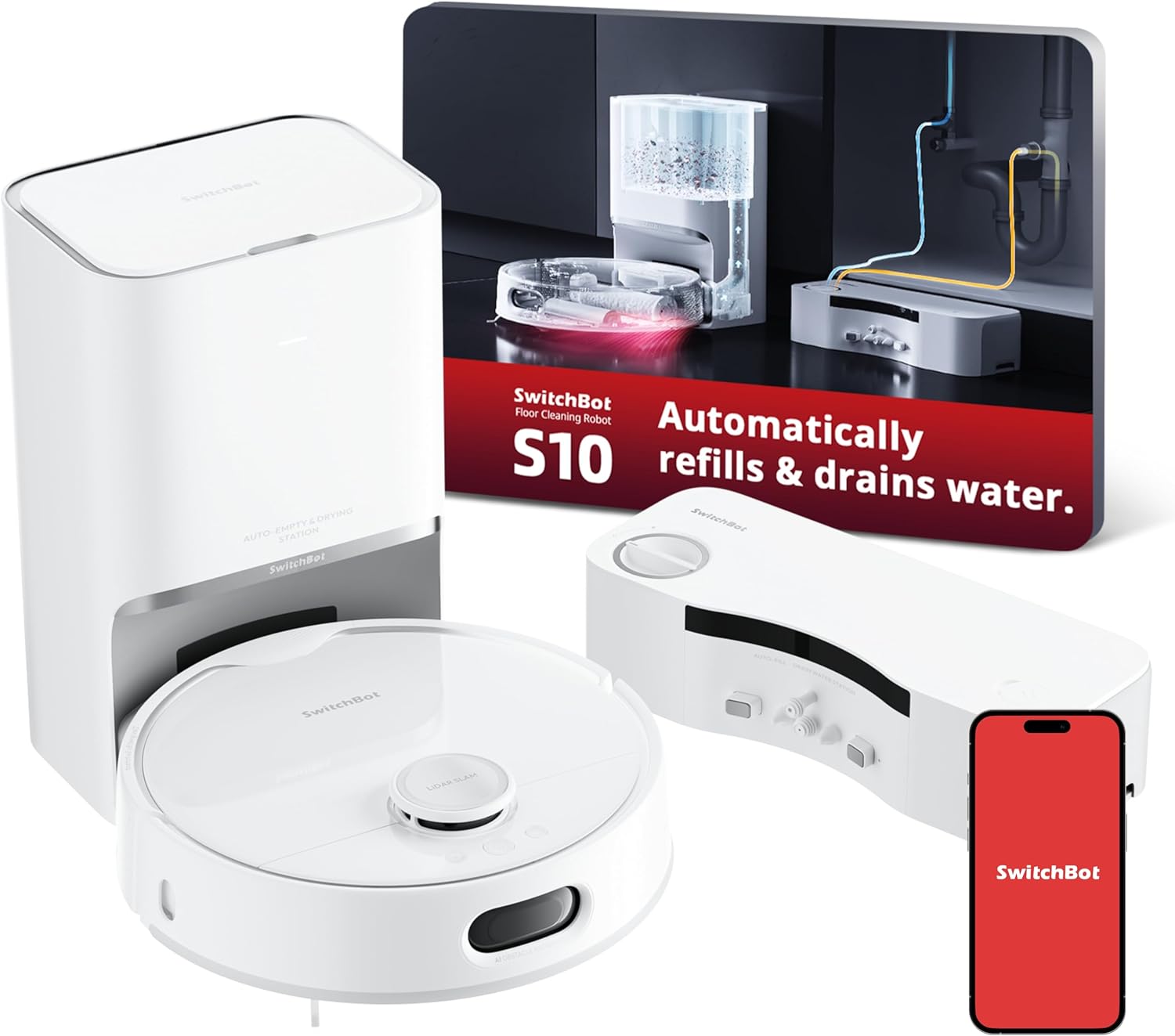
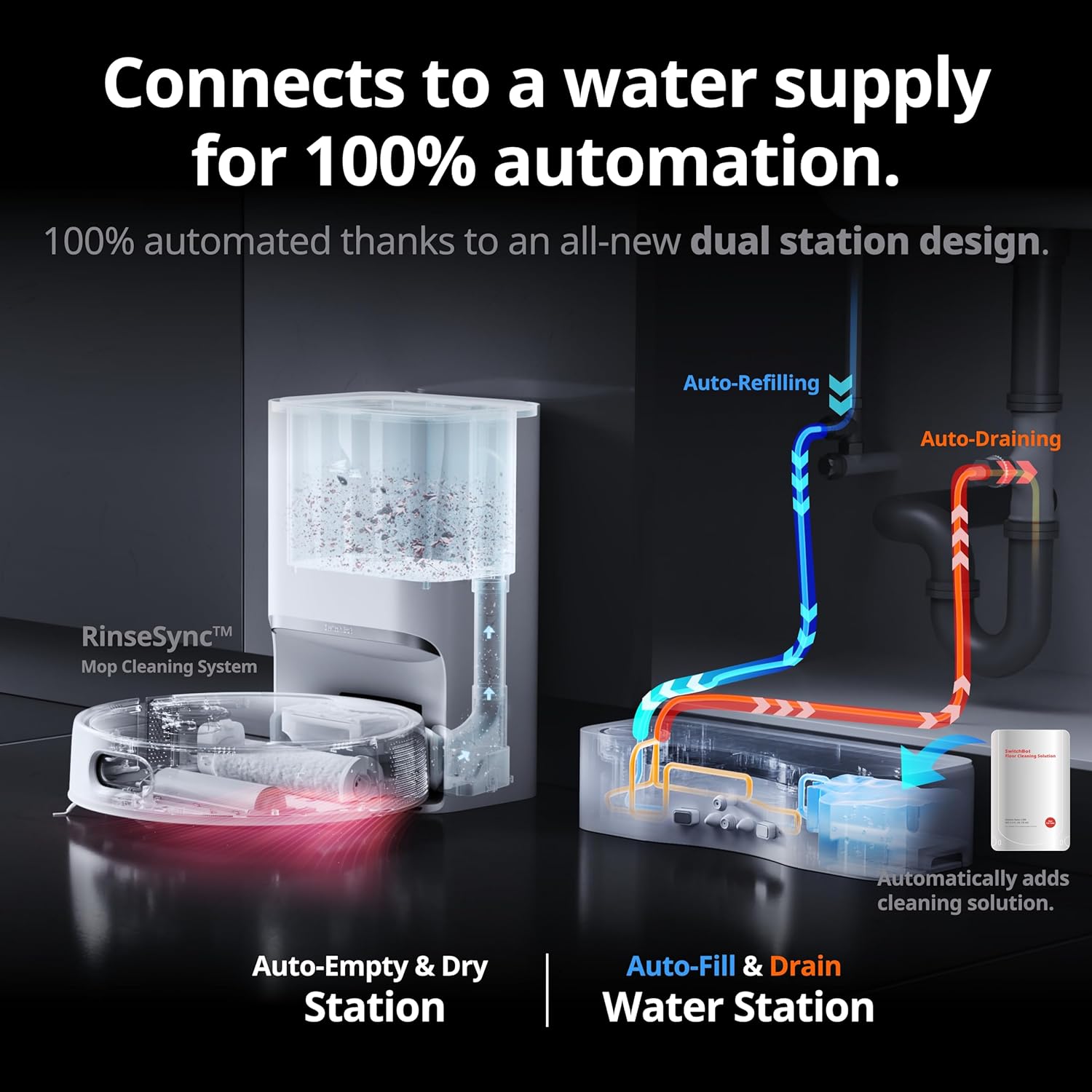
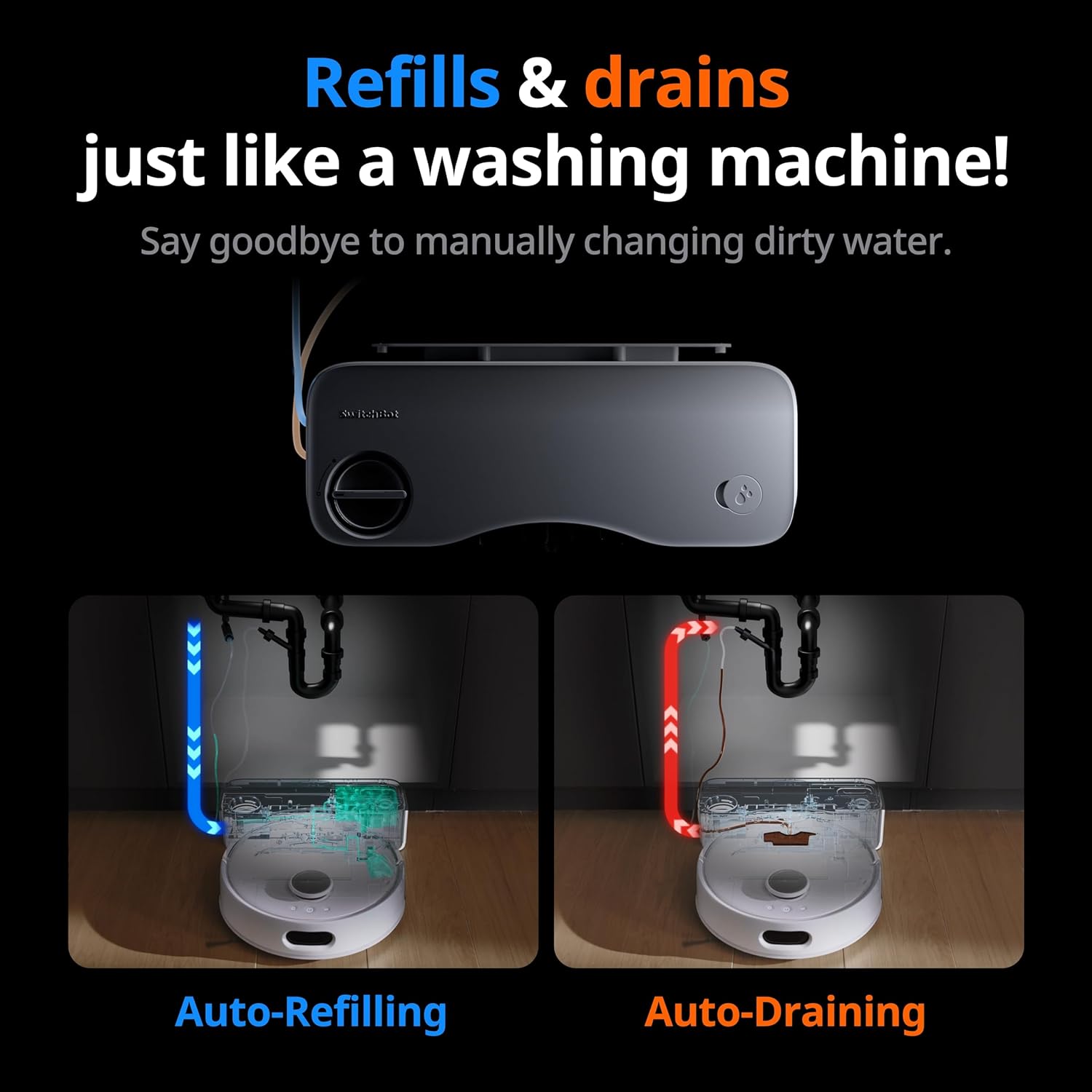
SwitchBot S10's most distinctive feature is not its suction number but its two-station architecture. One station handles dust collection and drying; a separate water station connects to household plumbing for refill and drainage. That could remove a recurring task that other automated mops leave with the owner: carrying clean and dirty water tanks. It also makes compatibility and placement the first steps in shopping. Confirm the available connection, drainage arrangement, access and permission to install before choosing the robot. A compelling cleaner on paper is not useful if its central water feature cannot be safely connected in the home where it will operate.
Two stations create two route requirements
Separating wet and dry service allows the dust dock to live away from the plumbing, which can be convenient. The robot still needs reliable access to both. A laundry-room door that is normally closed or a threshold that blocks the route to the water station can undermine the arrangement. Map the complete journey with ordinary furniture and doors in their normal state. Think about how the water station will be inspected and disconnected for service. In a rental, obtain the necessary installation permission and use the manufacturer's compatibility guidance. The design can reduce daily labour, but it should not be treated as a universal plug-and-play substitute for a tank dock.
The roller has a different cleaning rhythm
RevoRoll and RinseSync are intended to refresh the roller during mopping, removing residue from the contact surface as the robot works. That is a different approach from pads that are washed periodically at a dock. It may be particularly useful in a kitchen where a dirty pad would otherwise continue across the room. The removed material still travels through a water path, so the roller, scraper and drainage components deserve inspection. Follow the manual's limits on debris and liquids. A machine that uses water continuously is not automatically approved to collect every spill, and a blocked wet path can turn convenience into a more involved maintenance task.
Vacuuming should be tested independently
SwitchBot advertises 6,500 Pa suction and automatic adjustment around carpets, including mop lifting. Those features make it a combined cleaner, but the wet architecture should not distract from dry pickup. Inspect crumbs, fine grit and embedded hair separately. Check the brush and collection route after several pet-heavy runs. We have not measured carpet extraction or the effectiveness of its lifting behaviour on different rugs. Observe the first transition with a wet roller and use a suitable exclusion or separate routine where the rug requires it. A low-pile demonstration cannot approve a thick or delicate carpet in the owner's home.
Ecosystem features should follow the cleaning need
S10 can be controlled through the SwitchBot app and supported voice integrations, and the manufacturer positions it within a broader connected-home ecosystem. Those options are useful when they make a specific routine easier, such as starting a kitchen task at a sensible time. They should not be the reason to overlook plumbing or floor suitability. Verify which integrations require additional hardware or account connections in the current regional setup. Start by ensuring the robot reliably completes its own cleaning and both service visits. Add wider automations only after that baseline is dependable, so a complicated smart-home sequence does not obscure a simple docking or water-service problem.
The verdict is unusually home-dependent
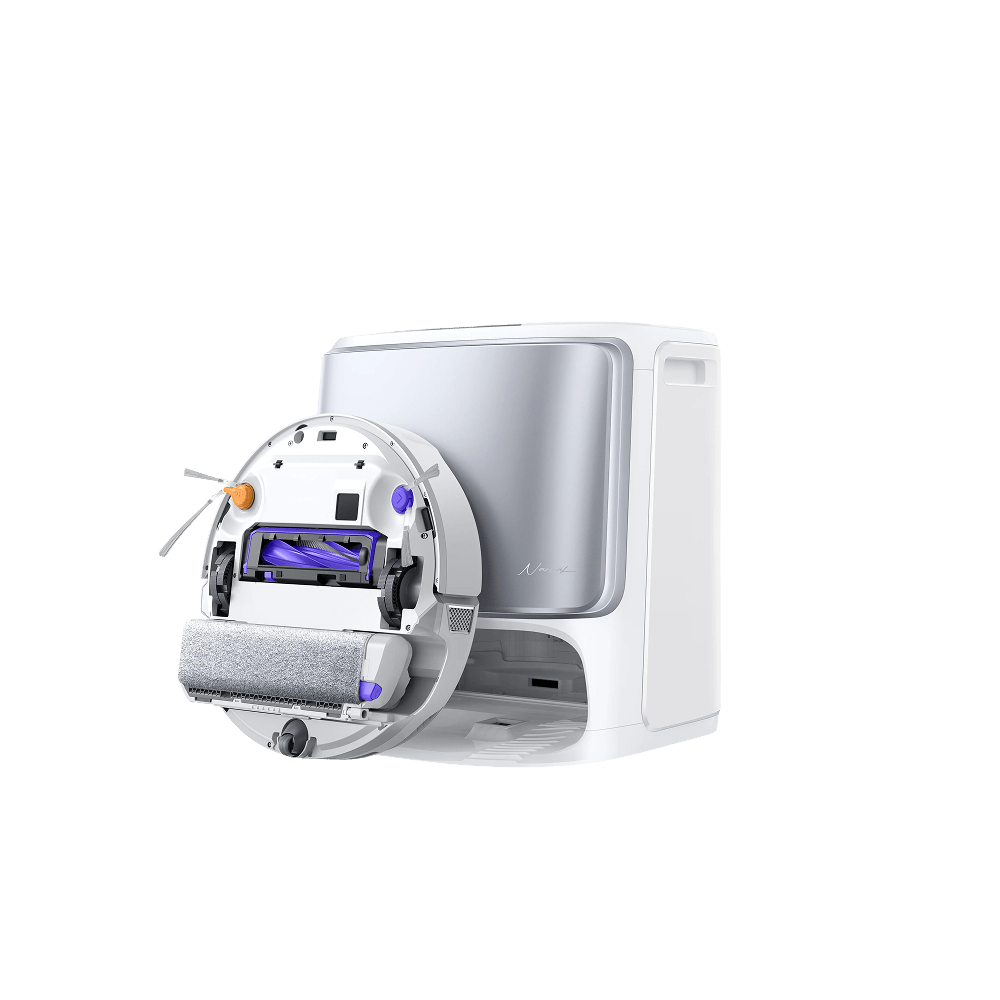
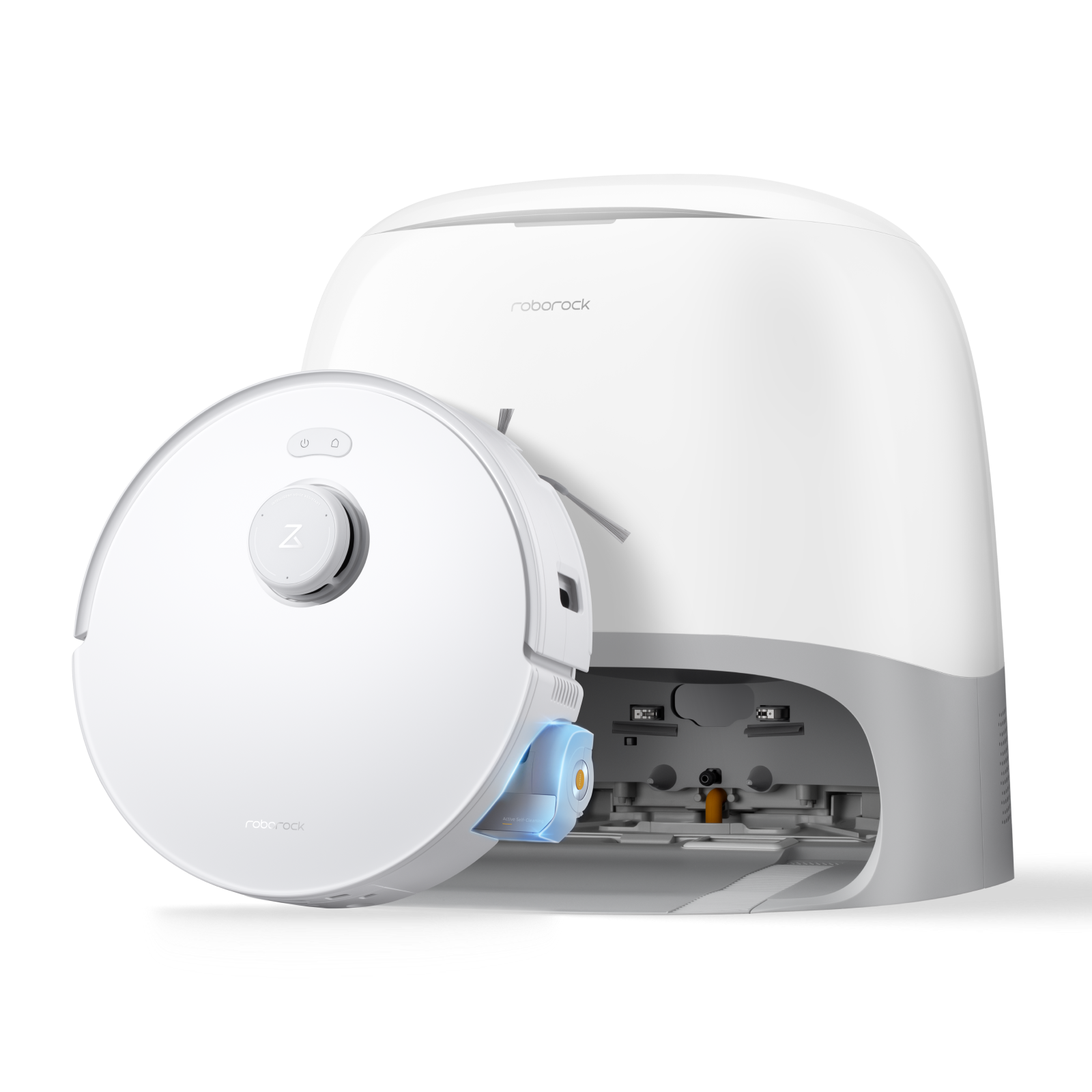
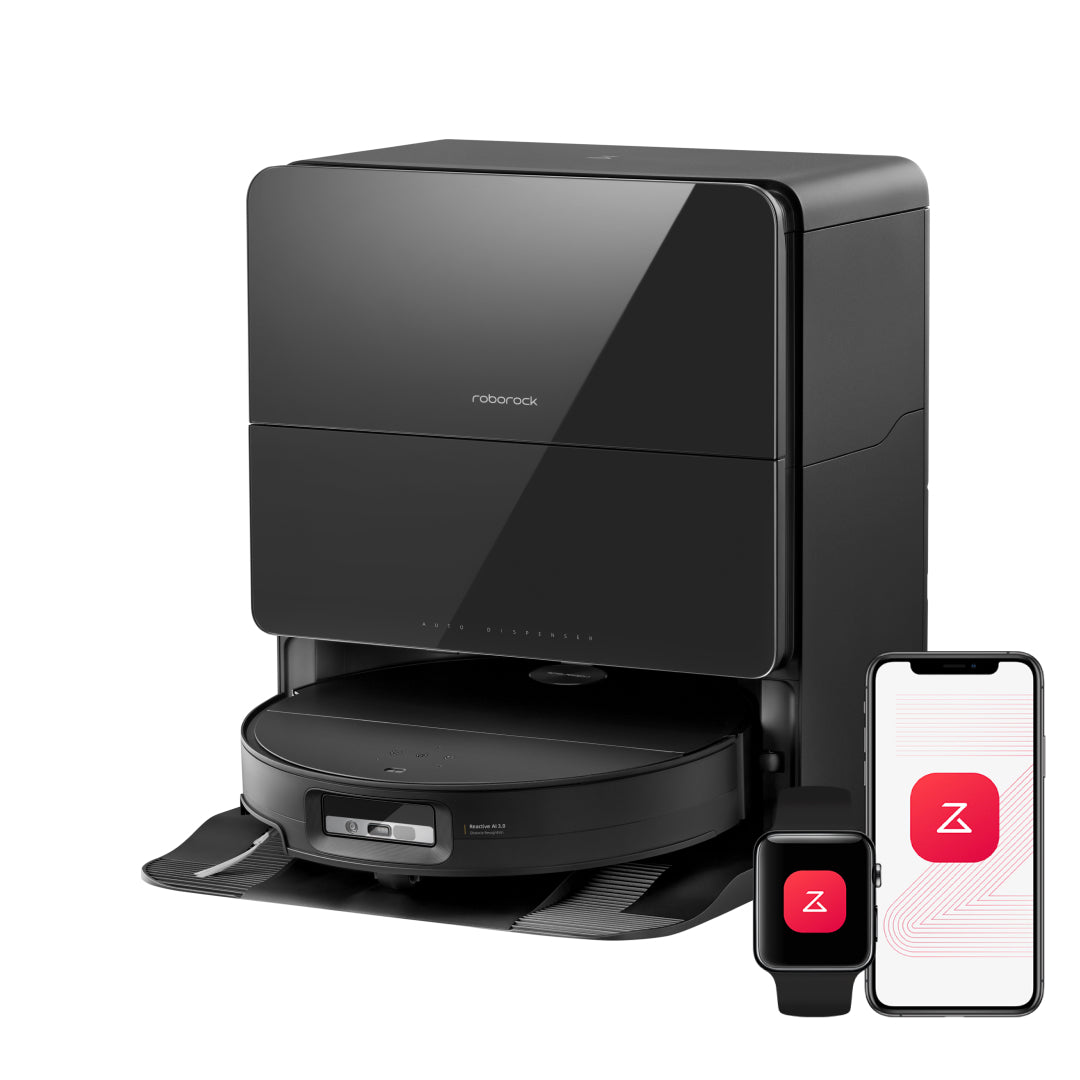
Compare S10 with Narwal Flow and Qrevo Curv 2 Flow for other continuously refreshed wet-cleaning designs, while recognising that their standard station arrangements differ. S10's clearest potential advantage is reduced tank carrying through a separate plumbed water point. We have not tested its roller cleaning, drainage reliability or installation effort. A useful follow-up should document the exact connection, leak-free service, route completion, water-path maintenance and floor residue over time. For a compatible home and a committed owner, the architecture is thoughtful. For someone unable or unwilling to arrange the water connection, a conventional tank-based system is the more natural starting point.
Commissioning the two-station water route
S10 installation should begin with the manufacturer's compatibility guidance for the water station. Identify the permitted supply and drain arrangement, access for inspection and any landlord or building requirements before connecting anything. Use appropriate installation help where necessary. The water station being compact and cable-free does not remove the need for a sound plumbing arrangement. After installation, observe refill and drainage and check connections as directed. Establish how the system is isolated for maintenance. Keep the robot's route to that station unobstructed, including the door normally used to close a laundry area. This is a household infrastructure decision as well as a vacuum purchase, and its usefulness depends on the water service remaining accessible without someone repeatedly opening rooms or carrying the robot.
The separate dust-and-drying station needs its own stable location. Test a complete cycle that includes both stations rather than only a successful return to one of them. Note which journey fails if the robot stops, because a map issue, a threshold and a water-service fault need different remedies. Inspect the RevoRoll and accessible wet path after several ordinary kitchen tasks. Direct drainage removes tank carrying but does not remove residue from every internal component automatically. Follow the care procedure and avoid collecting unapproved liquids or debris. Keep the correct roller and other wear-part references with the installation notes so maintenance can be performed without searching through accessories for unrelated SwitchBot models.
Smart-home integration should be added after cleaning and both service visits work reliably. A complex automation can make a simple fault harder to diagnose, especially when multiple hubs or assistant accounts are involved. Verify current requirements for the chosen integration rather than assuming every SwitchBot device uses the same connection path. Review account access and map data, and ensure household members know how to stop the robot and isolate water if needed. The cited US listing describes a one-year warranty; Canadian buyers should obtain the terms applicable to their seller and installation. Compare the cost of fittings, setup and ongoing roller care with a tank-based alternative. S10's clear advantage is reduced water carrying, but that saving should be weighed against the responsibility of maintaining a plumbed appliance and two reliable robot routes.
If a household regularly closes the room containing the water station, include that habit in the trial rather than leaving the door open artificially. The S10 needs an operational route to both service points when the task requires them. A reminder or changed schedule may be necessary, and that remaining intervention belongs in the ownership calculation.
Sources & further reading.
These are the sources behind this research review. Manufacturer claims are not independent performance measurements. Community accounts, when cited, describe individual experiences.
Documentation reviewed: 9 October 2026. Product software and regional bundles can change. Corrections and editorial disclosures.