An editorial assessment of documented capabilities and ownership trade-offs. This is not a hands-on test result or a measurement of reliability.
Task capability 30%8.6
Supported object relocation adds capability, but the narrow object and payload limits constrain usefulness.
Navigation & control 20%8.5
StarSight plus remote arm control offers flexibility, with additional decision and supervision burdens.
Ownership & upkeep 20%7.0
Full dock care is offset by a specialised manipulator requiring inspection and support.
Setup & usability 15%6.4
Safe arm zones, supported objects and drop locations make commissioning substantially more involved.
Documentation & support clarity 15%7.8
Payload and safety controls are documented; future software promises are excluded from this score.
Compare scores within the same product category. Small decimal differences should not override your needs or the evidence limits.
How the Standpoint Score works
We score five aspects of the documented product on a 0–10 scale, then calculate a weighted total:
- Task capability30% of the total
- Navigation & control20% of the total
- Ownership & upkeep20% of the total
- Setup & usability15% of the total
- Documentation & support clarity15% of the total
This product’s 7.8/10 is a provisional research assessment. It does not claim measured performance, tested reliability or a verified customer satisfaction rate. Compare it with products in the same category, and read each criterion’s reasoning above.
Read the full rubric and score bands ↗The ownership case.
The arm is genuinely distinctive, but a buyer should justify it against ordinary cleaning needs and supported objects rather than imagine a general-purpose home robot.
Reasons to consider it
- Can move certain supported small objects
- Low-profile body with extensive dock automation
- Arm can be disabled and has an emergency stop
Go in knowing
- Object handling has a limited scope
- Arm adds complexity and space requirements
- Future software promises should not drive the purchase
The specification sheet.
Published specifications from the linked sources. Configurations and availability can differ by country.
- Arm
- OmniGrip foldable five-axis arm
- Advertised payload
- Up to 300 g
- Navigation
- StarSight Autonomous System 2.0
- Advertised suction
- 22,000 Pa
- Body height
- 7.98 cm
The arm changes the question
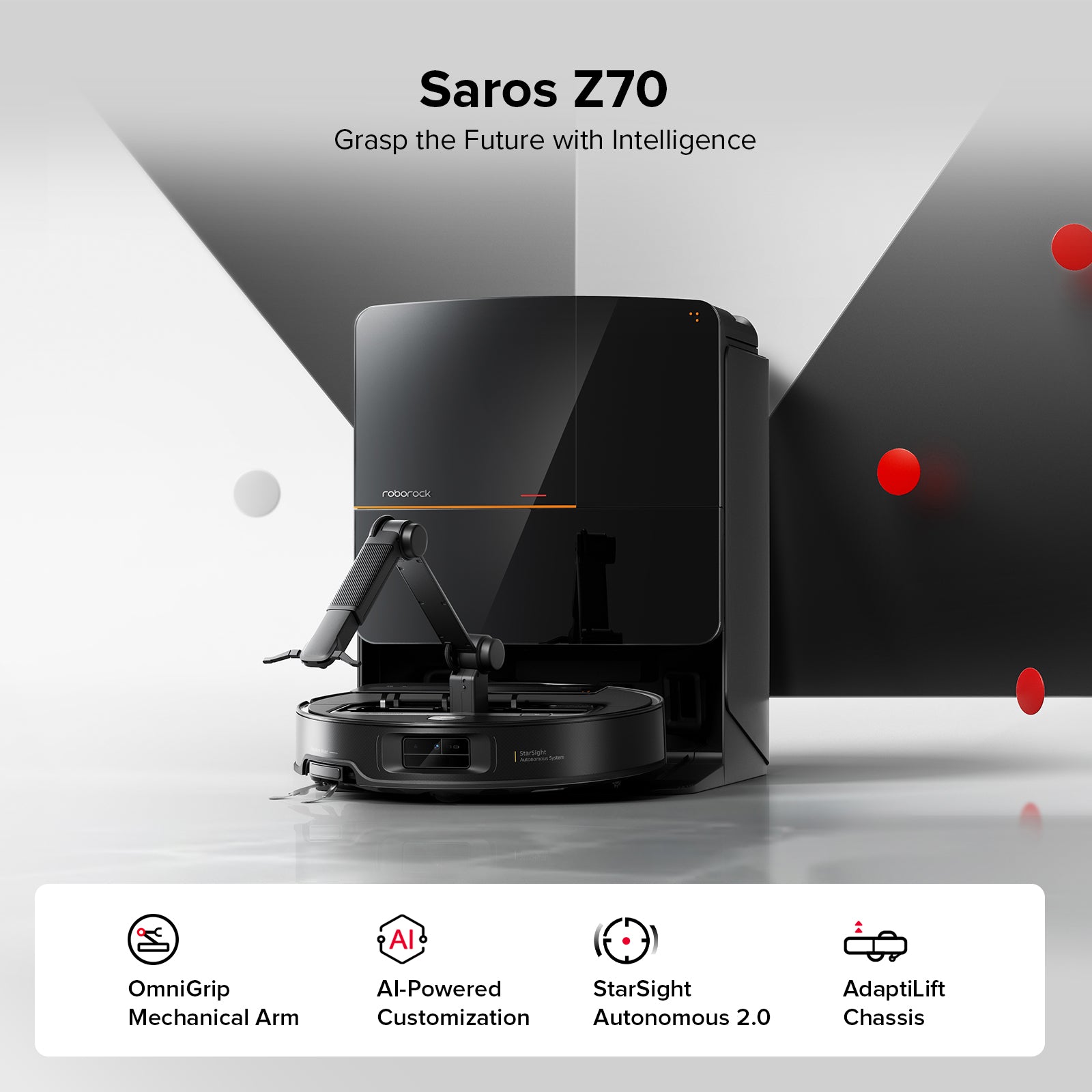
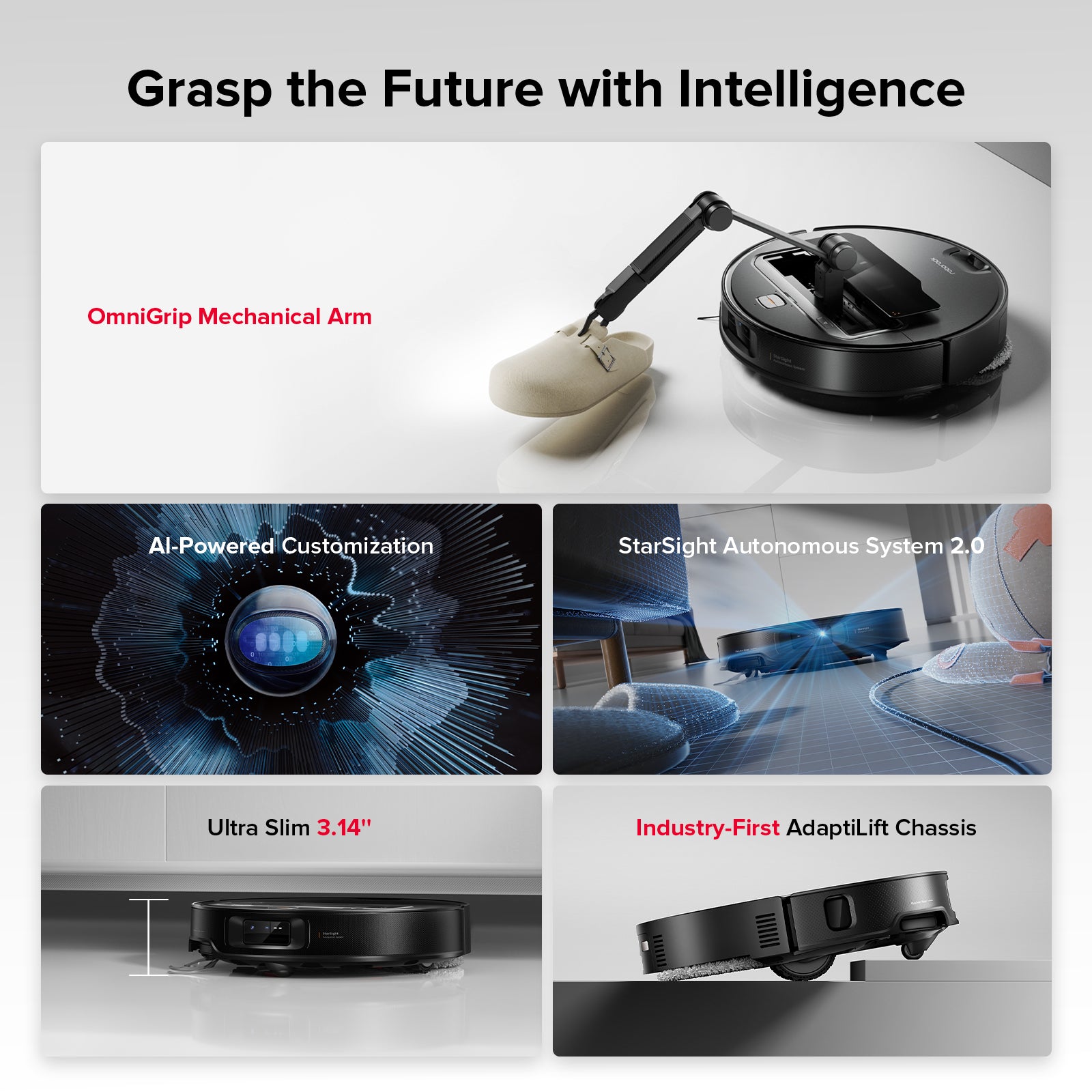
Most robot vacuums ask the owner to clear the floor. The Saros Z70 attempts a small part of that preliminary chore with OmniGrip, a folding five-axis arm. Roborock describes supported items such as socks, small towels, tissues and slippers within its payload limit. That is an intriguing change, but it remains a carefully bounded capability. A room containing cables, books, toys of different shapes and fragile ornaments is not automatically ready for a robot to tidy. The buyer should write down the objects they actually expect it to move and compare that list with the software's current supported behaviour. The overlap matters more than the spectacle.
A 300-gram limit is not a general lifting licence
Roborock's stated maximum payload is 300 g, and it recommends objects below that weight. Weight alone does not determine whether an item is appropriate: grip shape, flexibility, surface texture and where the object will be placed also matter. A light cable is not made safe by being light. The productive use case is a supported, predictable object obstructing a cleaning patch, moved to an agreed location. We would test recognition, grasp success, release accuracy and the total time added to a run separately. A successful pickup that requires repeated phone supervision may be entertaining without actually saving effort. That difference should shape expectations from day one.
Cleaning hardware still has to do the ordinary work
The Z70 retains the low-profile body, liftable chassis and extending cleaning elements expected of an expensive cleaner. It also lists rotating mops, automatic mop removal and an extensive maintenance dock. These features matter because the majority of a cleaning session remains ordinary vacuuming and mopping. An arm demonstration cannot establish edge pickup, carpet extraction or stain removal. The mechanical compartment also makes efficient packaging important, so bin behaviour and service access deserve scrutiny. Compare the Z70 with the Saros 10R on the same cleaning tasks with object handling disabled first; only then is it possible to isolate what the arm adds to a household routine.
The dock cannot maintain the manipulator for you
The automated wash, dry and empty functions reduce the recurring work associated with the vacuum and mops. They do not answer all the maintenance questions introduced by a folding arm. Keep its deployment area free, inspect the gripping surfaces and follow the manual for cleaning or troubleshooting the assembly. Do not force a joint back into place if it fails to retract. The whole robot may need service when a specialised mechanism fails, so ask how repairs and shipping work in your country. A purchase made primarily for experimentation has a different acceptable inconvenience budget from a purchase meant to replace an everyday chore.
A distinctive machine with a narrow recommendation
The Z70 is most defensible for someone who understands exactly what a limited manipulator can do and wants that capability now. It is harder to recommend merely because it is the most elaborate model in a range. Buy only the supported features available in the current regional firmware, not a future list of objects mentioned in promotional material. Our most important missing evidence is a repeatable, weeks-long count of successful relocations, failed attempts and time saved compared with clearing the floor by hand. Until that exists, the arm is an interesting practical experiment attached to a well-specified cleaner, rather than proof of a house that can tidy itself.
Owning a cleaner with a manipulator
The Z70 deserves a commissioning plan that separates its arm from its cleaner. First establish mapping, ordinary pickup, mop care and docking with the arm disabled. Then introduce a small set of supported, harmless items one at a time and define where each should go. Record missed recognition, failed grips, dropped items and tasks that required remote control. This is not an adversarial stress test; it is a practical way to discover whether the household's common socks or slippers resemble the supported examples closely enough to be useful. Avoid fragile objects, trailing cords and anything important even when it weighs less than the payload limit. Weight is only one part of suitability. The acceptance criterion should be useful, repeatable relocation without supervision that takes longer than doing the job manually.
Arm deployment also changes where the robot can safely operate. A low body may vacuum underneath furniture while the manipulator needs more open space to extend. Establish no-relocation areas around play projects, pet bedding and collections intentionally arranged on the floor. Show household members how to disable the arm and use the emergency stop, then keep the machine's moving parts out of casual play. Do not force the gripper or joints if an object becomes lodged. Capture the error and follow the service guidance. A specialist mechanism is less likely to be solved sensibly with the same improvised cleaning approach used for a tangled side brush. Before purchase, ask whether arm-related repairs require sending the whole robot and whether local support handles that exact regional model.
The financial comparison should isolate what the arm costs you in money, complexity and attention. Price the Z70 against a cleaner such as the 10R that meets the floor-care need, then decide whether the documented object handling supplies enough additional value. Do not include promised future object categories in that calculation. Optional camera views from the body and gripper also need an explicit household-access decision; they are useful for remote control but expand how the appliance can be used to observe a room. Keep software current and review the permission choices after major updates. For a Canadian buyer, regional availability of parts and support may be more important than a US sale. A worthwhile experiment can still be a poor everyday appliance if its distinctive component is difficult to service or seldom completes a useful task.
Sources & further reading.
These are the sources behind this research review. Manufacturer claims are not independent performance measurements. Community accounts, when cited, describe individual experiences.
Documentation reviewed: 9 October 2026. Product software and regional bundles can change. Corrections and editorial disclosures.