An editorial assessment of documented capabilities and ownership trade-offs. This is not a hands-on test result or a measurement of reliability.
Task capability 30%8.4
Articulated AWD targets demanding terrain; height range is narrower than 440 iQ.
Navigation & control 20%8.1
EPOS and articulated movement offer a distinctive control proposition.
Ownership & upkeep 20%6.9
Specialised chassis and restricted underside cleaning add ownership demands.
Setup & usability 15%6.7
Steep-property surveying and recovery planning require particular care.
Documentation & support clarity 15%6.0
Conflicting area references reduce specification clarity.
Compare scores within the same product category. Small decimal differences should not override your needs or the evidence limits.
How the Standpoint Score works
We score five aspects of the documented product on a 0–10 scale, then calculate a weighted total:
- Task capability30% of the total
- Navigation & control20% of the total
- Ownership & upkeep20% of the total
- Setup & usability15% of the total
- Documentation & support clarity15% of the total
This product’s 7.4/10 is a provisional research assessment. It does not claim measured performance, tested reliability or a verified customer satisfaction rate. Compare it with products in the same category, and read each criterion’s reasoning above.
Read the full rubric and score bands ↗The ownership case.
The 435 iQ AWD is the terrain-focused member of this group, not automatically the best iQ for every large lawn. Its shorter cutting-height range and conflicting capacity statements make an exact site-and-SKU confirmation especially important.
Reasons to consider it
- Articulated all-wheel-drive chassis
- 70% internal slope claim
- EPOS and app-managed zones
Go in knowing
- Capacity wording conflicts on source page
- Maximum cut height below 440 iQ
- Underside is not hose-washable
The specification sheet.
Published specifications from the linked sources. Configurations and availability can differ by country.
- Internal slope limit
- 70% / approximately 35°
- Drive
- All-wheel drive, articulated body
- Cutting-height range
- 1.2–2.9 in
- Object detection
- Ultrasonic listed
- Published area
- Page contains differing 1.3-acre and 0.9-acre references
- Cleaning
- Underside hose washing not approved in FAQ
Buy the articulation for a real problem
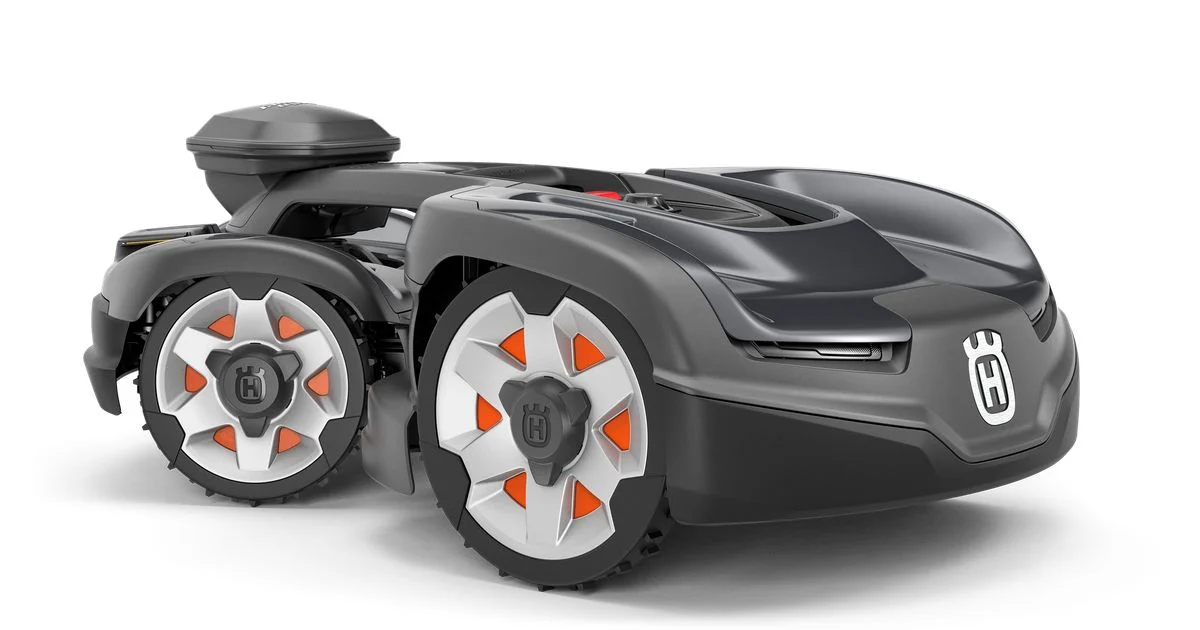
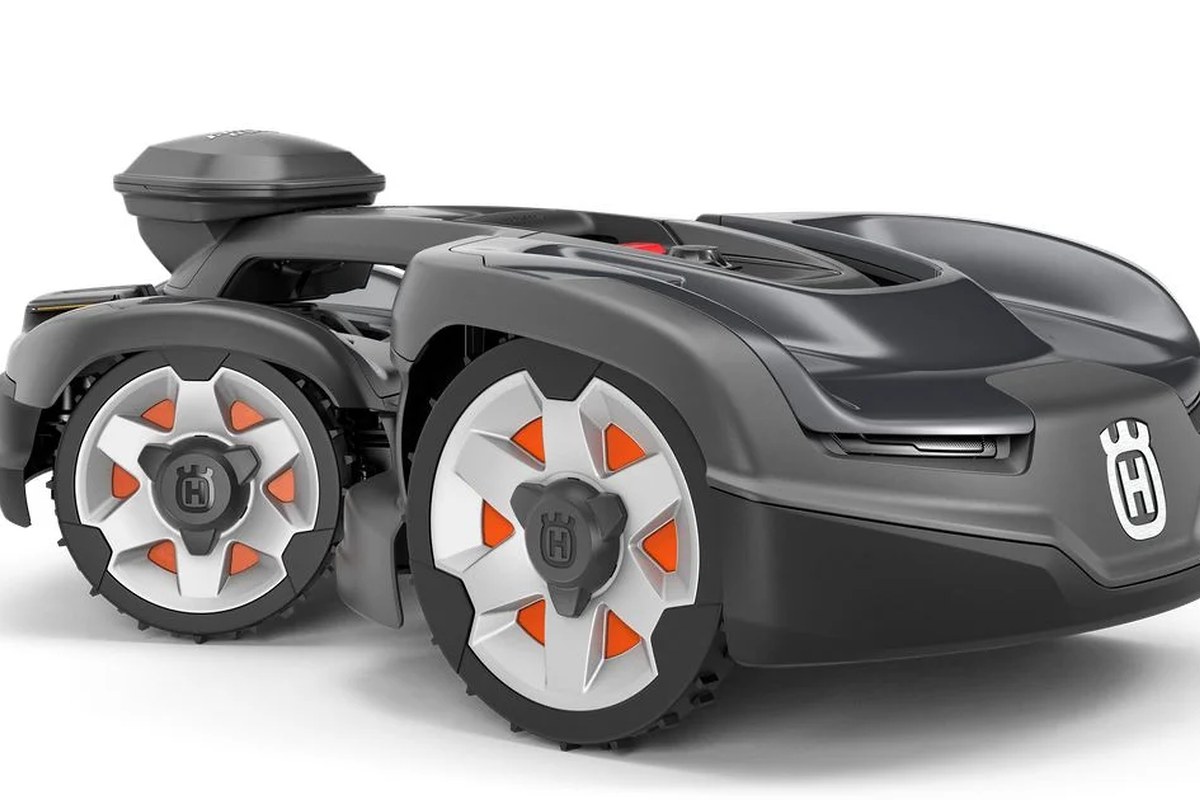
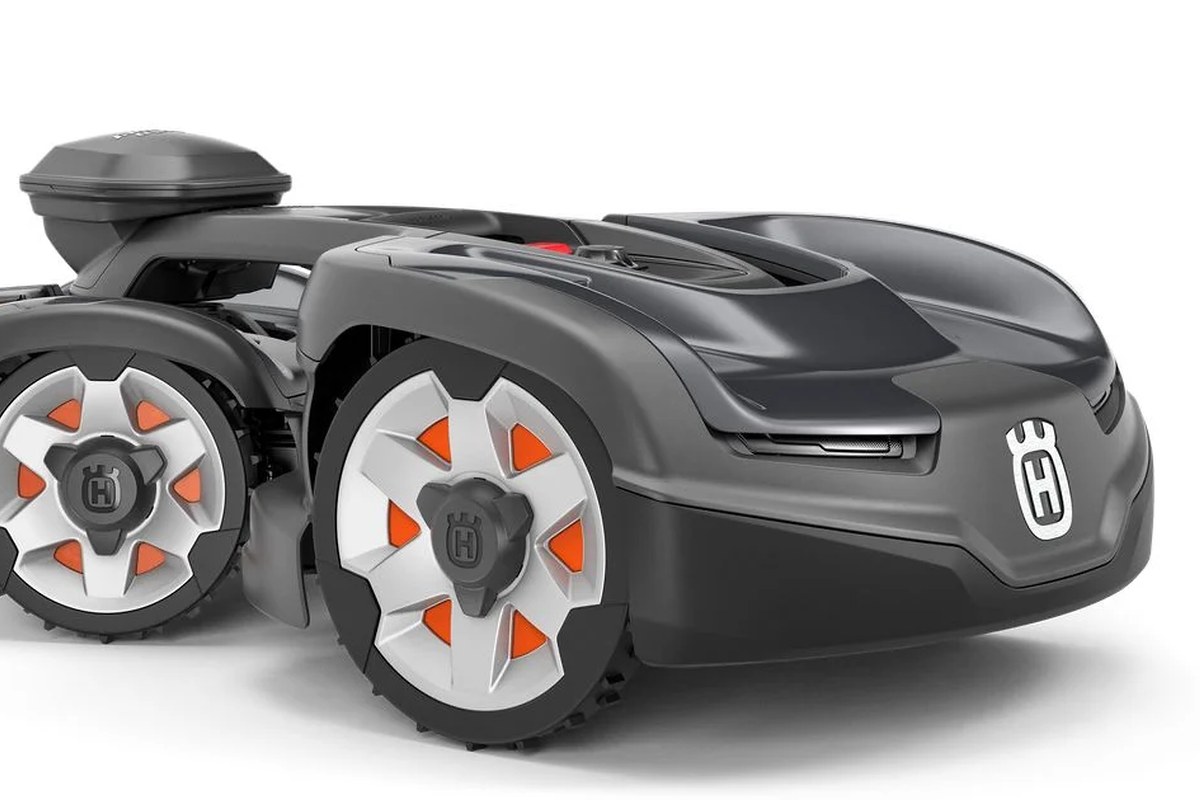
The 435 iQ AWD is visually and mechanically different from the conventional iQ models. Its articulated body and all-wheel drive target traction and manoeuvrability on difficult terrain. Husqvarna publishes a 70% internal slope capability, about 35 degrees. That is a meaningful reason to investigate it for a banked property, but not a reason to buy it for an ordinary flat lawn where capacity or cutting height matters more.
The reviewed page contains an important inconsistency: the prominent capacity is 1.3 acres, while its FAQ describes 0.9 acres. We would obtain the applicable capacity, mowing pattern and SKU in writing rather than silently choose the larger figure. This is exactly the sort of detail that a dealer demonstration should resolve. A research review can expose the discrepancy; it cannot convert it into a tested performance claim.
Steep lawns create more than traction demands
A mower that climbs a bank still needs space to turn, maintain position and recover when conditions change. The articulation may help its wheels remain useful on uneven ground, but the practical questions include turf disturbance, ruts, roots and safe margins near a drop. Test representative turns, not just a straight climb. Repeated work on the same fragile patch can make a successful traversal an unacceptable lawn-care routine.
The cutting-height range is listed as 1.2–2.9 inches in the FAQ. That is materially different from the four-inch maximum advertised for the 440 iQ. Owners who keep grass tall should not trade that requirement away simply to gain AWD. The mower also uses ultrasonic object detection according to the specification, so it should not be described as having the same sensing arrangement as every other iQ model.
An ownership plan for a specialised machine
Husqvarna explicitly says the underside is not approved for hose washing. That distinction matters because other iQ pages promote hose-cleanable bodies. Cleaning technique should follow the actual manual, particularly around the articulated drive and cutting equipment. A muddy, steep property may require more inspection than a dry, level demonstration garden, and that maintenance time belongs in the comparison with other AWD robots.
The sensible alternatives include a less specialised iQ if the terrain is moderate, or a different AWD design if local service is limited. Our first hands-on priorities would be hill turns, rough-ground consistency, charging approaches and residual edge work. We would also track how easily one person can recover the machine from an awkward position. The specification supports a serious terrain proposition, but the decisive evidence must come from the difficult sections of the actual lawn.
A practical acceptance test before relying on it
The most informative 435 iQ AWD demonstration would include a turn on representative sloping ground, followed by an inspection of the grass and a return to charge. A straight climb alone leaves too many questions unanswered. Keep the test within the confirmed manual limits and away from dangerous drops. We would repeat it under ordinary safe conditions, then compare the turning space with a conventional iQ. The articulated chassis should solve a real terrain problem while preserving acceptable turf. Before any trial, resolve the page's competing area figures with the dealer; otherwise even a successful demonstration may be used to support an unsuitable whole-property plan.
Setup, maintenance and the ownership decision
The articulated 435 iQ AWD requires a different installation mindset from the conventional iQ chassis. Walk the turning points, narrow routes and changes in grade with the dealer, including the places where the rear section must swing. A gap that admits the front of the machine may still leave an awkward manoeuvre at the exit. The dealer should demonstrate the complete route to the charging station on representative ground. We would avoid locating the dock merely where it is hidden from view if doing so requires repeated difficult turns or a steep final approach.
The lower maximum cutting height compared with 440 iQ is a genuine purchase constraint. An owner who needs a four-inch finish should resolve that requirement before accepting the terrain benefit. Likewise, obtain written clarification of the competing area figures on the page and the operating mode associated with the delivered SKU. A capable climbing chassis cannot create extra scheduled capacity or a different height range. The strongest case for this model is a property where its particular mechanical design removes substantial manual work that an ordinary mower cannot handle comfortably.
Cleaning is notably model-specific. Husqvarna's FAQ says the underside is not approved for hose washing, so the easy-clean advice on other iQ pages should not be transferred here. Ask for a demonstration of dry debris removal and access around the articulation and cutting system. Disable the mower exactly as the manual requires before working underneath it. A sloping or damp lawn may increase accumulation around wheels and moving sections, and that time belongs in the ownership calculation. Consumable blades remain a routine item even when the chassis is more sophisticated than its siblings.
Ultrasonic detection, lift and tilt sensing and location features are listed, but none is a substitute for a safe operating area. Give slopes beside water, roads or retaining walls conservative protection and observe the manual's boundary requirements. Do not use a climbing demonstration to infer safe braking or recovery in every condition. The owner should practice local stopping and recovery on easy ground before the robot works in awkward places. App permissions and account handover matter as well, particularly if a professional installer or previous owner originally controlled the machine.
Service economics should reflect the specialised hardware. Ask whether the local workshop routinely handles articulated AWD Automowers and what transport arrangements it offers. Obtain prices for likely wear items and clarify warranty coverage for the mower and battery separately. A general outdoor-equipment dealer may not provide the same practical support as a technician familiar with this chassis. The 435 iQ AWD can justify its complexity on the right banked property, but it deserves a complete installation and repair plan. Buying it simply because it is the most dramatic-looking iQ risks paying for capability that the lawn does not need.
Seasonal storage and return to work
Seasonal care should include a close look at the 435 iQ AWD's articulation, wheels and difficult routes, using the inspection method in its manual. Do not wash the underside merely because another iQ model permits it. After storage, demonstrate an easy route before returning to slopes, then check whether winter weather altered turning margins or exposed roots. Keep a record of the confirmed cutting-height and capacity specification with the machine. The specialised chassis benefits from a deliberate recommissioning routine that respects its own maintenance requirements.
Sources & further reading.
These are the sources behind this research review. Manufacturer claims are not independent performance measurements. Community accounts, when cited, describe individual experiences.
Documentation reviewed: 9 October 2026. Product software and regional bundles can change. Corrections and editorial disclosures.