The ownership case.
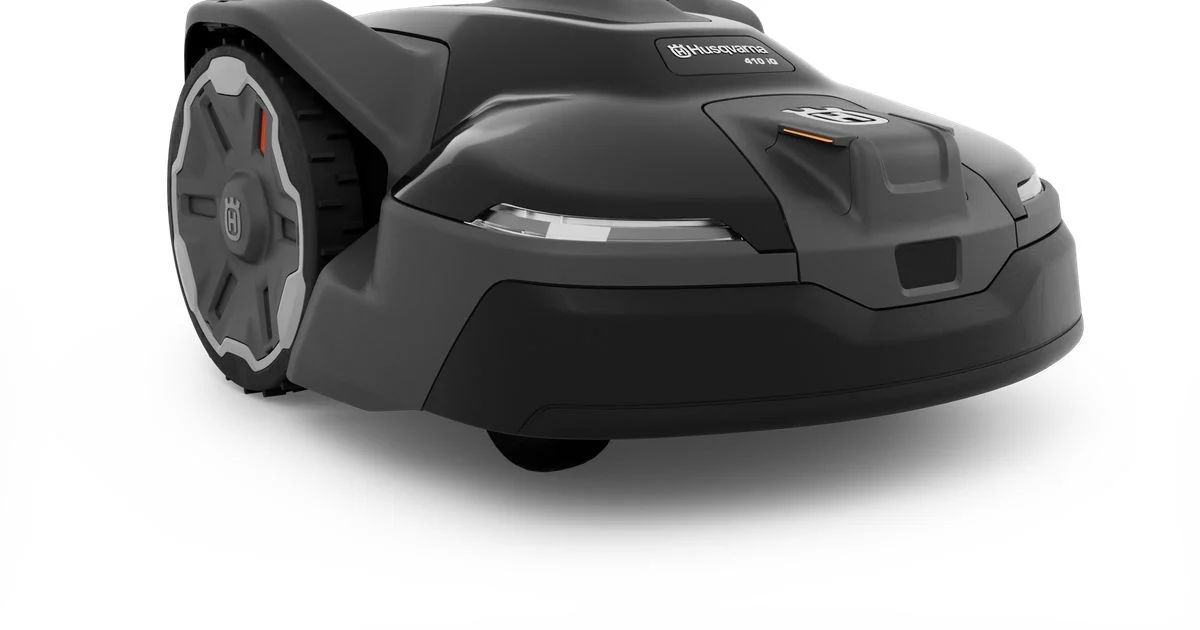
A plausible choice for a smaller US or Canadian lawn with a workable satellite installation and a helpful local dealer. The slower charge cycle and lower random-pattern capacity deserve more attention than the half-acre headline. We have not tested its cutting performance or intervention rate.
Reasons to consider it
- Reference station included in the documented US/Canada package
- 1–4-inch electrically adjusted cutting height
- Physical and virtual boundary options
Go in knowing
- 108-minute stated recharge versus 54 minutes on the 420 iQ
- Random-pattern capacity is 0.25 acre rather than 0.5 acre
- Radar does not remove the need to clear low obstacles and debris
The specification sheet.
Published specifications from the linked sources. Configurations and availability can differ by country.
- Region / article number
- US/Canada, 970 72 74-01
- Systematic capacity
- 0.5 acre
- Irregular capacity
- 0.25 acre
- Typical mowing / charging
- 84 / 108 minutes
- Cutting width / height
- 9.4 inches / approximately 1–4 inches
- Slope inside / at boundary
- 45% / 15%
- Boundary methods
- Physical wire or virtual boundary
- Connectivity
- Cellular, Wi-Fi, Bluetooth
- Controls
- Automower Connect; jog wheel and colour display
- Object detection
- Radar
- Published weight
- 38 lb (current product page)
- Security
- PIN, alarm, geofence, GPS theft tracking
The half-acre headline has a second number
Husqvarna lists the 410 iQ at 0.5 acre for systematic mowing and 0.25 acre for an irregular pattern. These are different operating modes, not interchangeable descriptions of the same coverage. A buyer with a lawn approaching half an acre should decide which pattern will actually be used before treating the smaller iQ as sufficient. Choosing random movement for its appearance or installation arrangement changes the published capacity available to that decision.
Measure the grass rather than the property boundary. A house, driveway and planted beds may make a half-acre parcel a much smaller mowing job; long strips and separate work areas can make less grass awkward to reach. Capacity headroom is useful when the garden must also accommodate people. A robot that only fits the workload by occupying nearly every available window is a poor match for a household expecting frequent pauses. We would choose the model around the usable schedule, then use the area rating as a check.
The 420 iQ comparison starts at the charger
The manufacturer gives the 410 iQ a typical 84-minute mowing period and a 108-minute charging period. The 420 iQ has the same stated mowing duration but a 54-minute recharge. Moving up does not buy twice as long a single outing. It reduces the pause between outings, a distinction that becomes important when the lawn is available only during selected hours.
A simple calculation makes the difference concrete. Ignoring travel and every other delay, an 84-minute cut followed by 108 minutes charging puts the 410 on the grass for about 44% of that cycle. With the 420’s 54-minute pause, the figure is about 61%. That is roughly 39% more theoretical mowing time per hour, not double the real-world throughput. These are calculations from published typical times, not measured coverage. Grass load, docking travel and the schedule can change the result. Still, the slower charger gives a useful reason to compare models beyond their names.
Wire-free setup still needs a suitable place
EPOS uses satellite positioning with correction data. Husqvarna’s current US page lists a reference station in the package and offers cloud corrections in selected locations. Confirm coverage for the actual address if planning to omit the local station. Cloud corrections should not be treated as a way to see through a roof or solve every obstruction above the mower.
The April 2025 operator manual describes clear sky visibility and a suitable docking approach for the reference-station installation. Think about the whole return route, especially the side of a house or a charging position beneath dense branches. The discreet corner that looks best from a patio may be inconvenient for navigation. A site visit is valuable if the lawn has substantial canopy or several enclosed strips. Ask the installer to demonstrate the difficult route rather than simply show that an open central area can be mapped.
A physical boundary remains an option
The specification supports physical as well as virtual boundaries; the product page says loop wire is not included. That gives the buyer a choice of installation methods, but additional materials and work need to be included in the quote. It does not establish that the machine automatically switches between every navigation arrangement when reception becomes difficult.
Virtual stay-out zones are convenient when a patch of grass becomes a planted bed or a temporary obstruction needs a margin. The useful question is how that change affects access to the rest of the lawn. A narrow opening can become unusable after an otherwise sensible exclusion is added. Keep the map consistent with gates, parked vehicles and the household’s use of paths. A connection drawn on a screen needs a real passage that remains available when the mower is scheduled to work.
Height range matters more than decorative patterns
The 410 iQ has a 9.4-inch cutting width and an approximately 1–4-inch electrically adjusted height range. It uses three pivoting blades. This is a maintenance-cutting arrangement: its value lies in repeated small cuts, rather than replacing every task performed by a larger conventional mower. The ability to select a higher cut can matter more than the appearance of stripes for someone who already manages grass at that height.
Choose the target around the lawn’s requirements rather than the lowest number available. A mower that cannot reach the height you want is the wrong purchase even if it has excellent mapping. Conversely, a broad range does not demonstrate a clean finish under every grass condition. We have not examined clipping distribution, missed strips or the remaining edging on a 410 iQ. Those are separate performance questions that the blade count and height setting cannot answer.
Radar assistance has a practical boundary
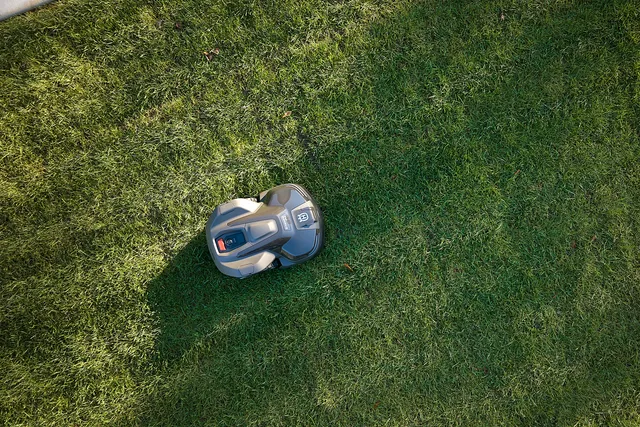
Radar object detection, lift and tilt sensors are listed. The shared iQ manual says object avoidance can respond to things taller than the grass and can leave uncut grass around them. That makes the feature useful to understand as a change in the mowing route rather than a guarantee that every object will be recognised correctly. Low roots and loose items still belong in the lawn-preparation checklist.
The slope figures also need careful reading: 45% inside the installation and 15% at the boundary. Percent gradient measures rise relative to horizontal distance; 45% is about 24 degrees, not 45 degrees. Where a bank ends at a path, the lower boundary limit can govern the layout. Keep children and animals out of the active work area as the manual requires. A sensor list does not establish permission to run cutting equipment during shared garden activity.
A phone connection and a positioning correction are different
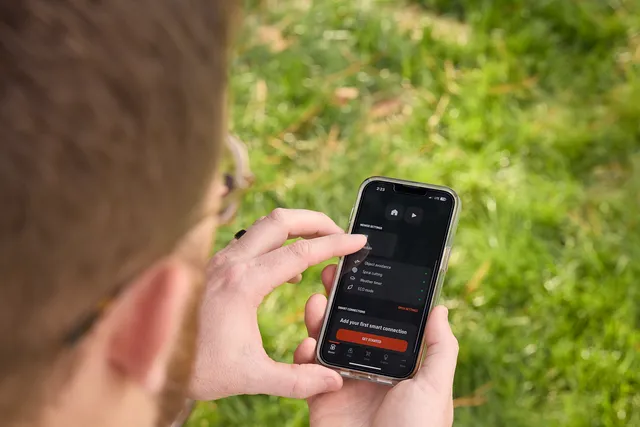
Cellular, Wi-Fi and Bluetooth are listed alongside Automower Connect and over-the-air firmware. The local interface uses a jog wheel and colour display. Understand which route is being used for app access and which provides positioning corrections; a weak home Wi-Fi signal at the far end of the garden does not answer both questions. Husqvarna says Wi-Fi is not required for mowing on the installation described by its current product FAQ.
The local controls are worth demonstrating during handover. Someone using the garden should be able to pause or park the machine without borrowing the primary owner’s phone. The listed PIN, alarm, geofence and GPS theft tracking provide several security tools, but recovery is a different outcome from an alert appearing. Keep the account accessible and understand its notifications. We have not tested location reporting, network loss or recovery on this model.
Cleaning and winter storage are part of the purchase
Hose washing is expressly described in the product FAQ. The operator manual permits low-pressure hose cleaning and prohibits a pressure washer or solvents; it calls for the machine to be switched off for maintenance. Do not turn a convenient cleaning feature into an assumption that every sealed part tolerates aggressive washing. Blade inspection and unobstructed moving parts still require attention.
For seasonal storage the manual specifies a fully charged, switched-off mower in a dry, frost-free area. That matters for Canadian owners whose winter storage space may be an unheated shed. Plan that space before installing a mower that will spend months away from its dock. Husqvarna advertises a four-year warranty for US and Canadian buyers on the current page; obtain the applicable written terms and service arrangement. Warranty duration does not tell you who collects the machine or how long a repair takes.
Where the smaller iQ earns its place
The 410 makes sense when the measured lawn and installation leave comfortable room below its relevant rating. Paying for the 420’s quicker recharge is less compelling if the smaller model has ample time and the grass area is modest. It becomes more relevant when family use compresses the schedule or several distant work areas consume travel time. Compare the complete installed system, including any wire materials, mounting work and service, rather than a mower-only offer.
Our conclusion is deliberately conditional. The documents establish what the 410 is designed to provide, including useful installation flexibility and a high-cut option. They do not establish a hands-on result for finish, traction, obstacle avoidance or seasonal reliability. A local demonstration on the difficult part of the property would settle more than an additional feature list. We are withholding a numerical Standpoint Score until the evidence supports a complete category assessment.
Sources & further reading.
These are the sources behind this research review. Manufacturer claims are not independent performance measurements. Community accounts, when cited, describe individual experiences.
- Husqvarna: Husqvarna Automower 410 iQ US/Canada product specifications ↗manufacturer
- Husqvarna: 410iQ / 420iQ / 440iQ operator manual, April 2025 ↗manual
Documentation reviewed: 9 October 2026. Product software and regional bundles can change. Corrections and editorial disclosures.