An editorial assessment of documented capabilities and ownership trade-offs. This is not a hands-on test result or a measurement of reliability.
Features & capability 30%8.7
Detailed APS-C capture, stabilization and dual slots support varied stills work.
Compatibility & connectivity 20%8.0
RF/RF-S and adapted EF options offer breadth, with exact compatibility checks required.
Ownership & upkeep 20%7.4
SD media and documented batteries help, while dense files and fast bursts add workload.
Setup & everyday use 15%7.9
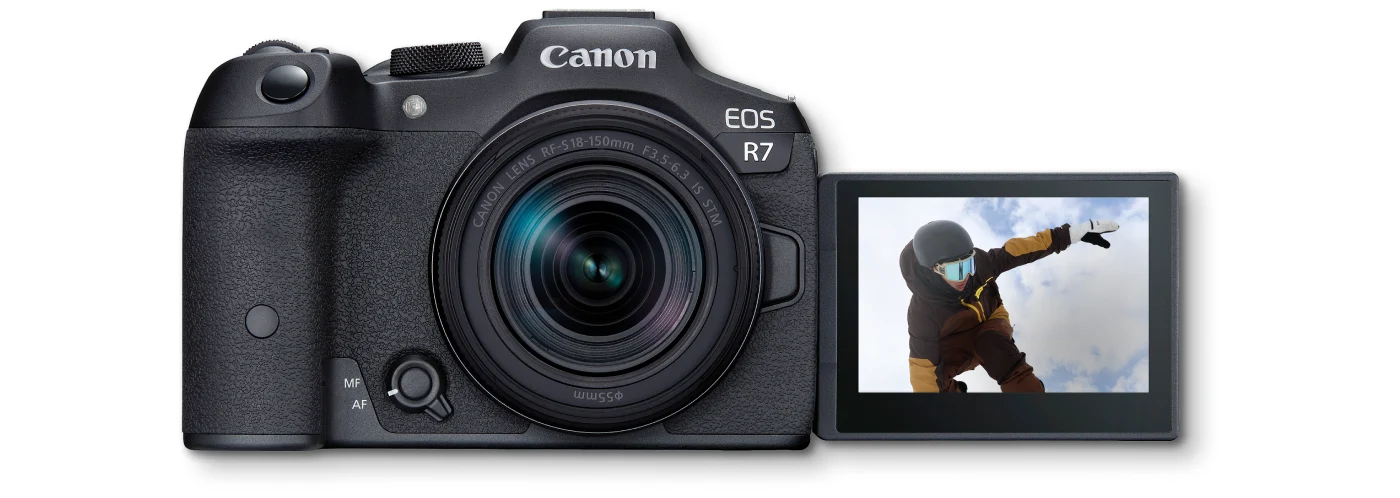
A vari-angle screen and extensive controls are useful once configured for the subject.
Documentation & support clarity 15%8.7
The detailed manual clearly distinguishes modes, media and power requirements.
Compare scores within the same product category. Small decimal differences should not override your needs or the evidence limits.
How the Standpoint Score works
We score five aspects of the documented product on a 0–10 scale, then calculate a weighted total:
- Features & capability30% of the total
- Compatibility & connectivity20% of the total
- Ownership & upkeep20% of the total
- Setup & everyday use15% of the total
- Documentation & support clarity15% of the total
This product’s 8.2/10 is a provisional research assessment. It does not claim measured performance, tested reliability or a verified customer satisfaction rate. Compare it with products in the same category, and read each criterion’s reasoning above.
Read the full rubric and score bands ↗The ownership case.
A compelling documented option for wildlife, outdoor action and detailed APS-C stills. Its high burst rates are tools to manage carefully, not evidence of guaranteed sharp sequences.
Reasons to consider it
- Detailed APS-C files suit carefully framed distant subjects
- Two UHS-II slots support practical recording arrangements
- In-body stabilization and microphone/headphone connections broaden use
Go in knowing
- Fast bursts generate substantial selection and storage work
- Electronic shutter behaviour needs checking with motion and artificial light
- Large full-frame lenses can make the complete kit considerably heavier
The specification sheet.
Published specifications from the linked sources. Configurations and availability can differ by country.
- Sensor
- 32.5 MP APS-C CMOS
- Mount
- RF and RF-S; EF/EF-S through compatible adapter
- Card slots
- Two UHS-II SD slots
- Stabilization
- Five-axis in-body image stabilization
- Maximum continuous shooting
- 15 fps mechanical; up to 30 fps electronic, subject to conditions
- Display
- 3-inch vari-angle touchscreen; approximately 1.62 million dots
- Battery
- LP-E6NH family; check version-specific compatibility
APS-C is a positive choice when distant subjects matter
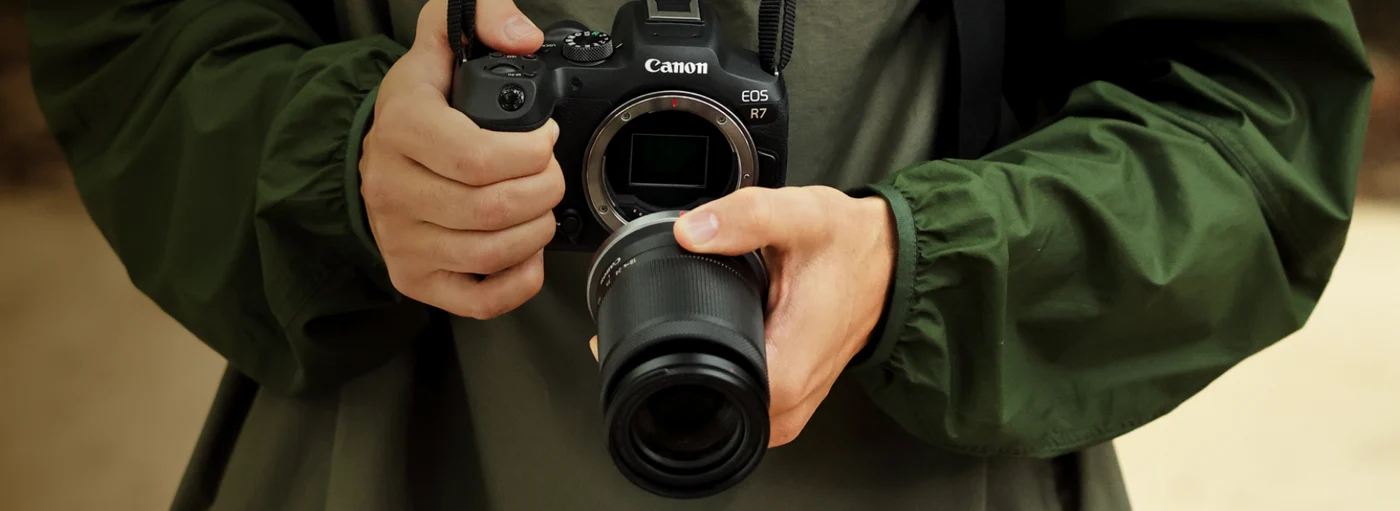
The EOS R7 is most interesting when a photographer wants a dense APS-C image without building the entire kit around a larger sensor. Wildlife and outdoor action are obvious uses, but detailed travel and close-up work can also benefit. The smaller sensor changes the angle of view for a given lens; it does not physically lengthen the lens or guarantee more usable detail in difficult light. Treat reach as a framing advantage to evaluate with the actual subject and lens.
The body also makes sense for Canon owners who want an additional camera with a different field of view. That purchase should be based on compatible lenses and a clear division of jobs. An existing full-frame zoom can be useful, though the resulting kit may no longer feel small. Our assessment is based on documented design and practical analysis. It does not claim measured tracking accuracy, image quality or weather resistance from field testing.
Resolution places useful pressure on technique
Canon specifies a 32.5-megapixel APS-C sensor. That gives the R7 considerable information to work with when a subject occupies enough of the frame, while also making focus and movement errors obvious at high magnification. A long lens used at an unsuitable shutter speed can lose the detail the buyer hoped to gain. Choose shutter speed for the subject's movement and the handling of the complete kit before worrying about keeping sensitivity at its lowest setting.
In-body stabilization helps address camera movement with supported configurations, but it does not immobilise an animal or a wind-blown flower. For careful close-ups, depth of field and support may dominate the result. For birds, anticipation and subject visibility may matter more than a small specification difference. Review finished exports as well as pixel-level crops. The value of the resolution is the photograph it allows you to deliver, not the amount of time spent searching for imperfections in an enlarged file.
Burst modes should match the scene
The published maxima reach fifteen frames per second with the mechanical shutter and thirty with the electronic shutter under specified conditions. These are different operating choices, not interchangeable promises. Electronic capture should be checked with fast movement and artificial lighting because scene conditions can affect the appearance of motion and banding. A buyer should learn when the quieter or faster option is useful and when another shutter setting is the safer choice for the intended photograph.
High frame rates also move work into the editing stage. A brief encounter with a subject can create many similar files, increasing card use and selection time. Practise controlled bursts and inspect a full sequence for focus consistency rather than selecting one sharp frame as proof of overall behaviour. During a used-body inspection, try the actual lens and card combination. These are recommended evaluation steps; this article does not provide a measured keeper rate or compare the R7's tracking against a newer processor generation.
Subject tracking works best with a fallback plan
Canon's subject-detection tools are part of the R7's appeal, but a photographer still needs a way to override the camera's choice. A bird partly covered by branches, an animal turning away or several people crossing the frame can make automatic selection ambiguous. Configure a focus-area method you can reach quickly and practise using it without lowering the camera. A well-understood fallback is more useful than assuming recognition will always identify the intended subject.
Lens behaviour also belongs in that trial. Adapted EF or EF-S equipment may be attractive to an existing owner, but the exact lens and adapter should be checked for the functions that matter. EF-M lenses are a different system and should not be confused with the compatible families. Test focus operation, aperture control and handling together. A camera purchase that depends on reusing one particular lens should be evaluated as that combination, rather than on a shop demonstration with a different native zoom.
Two SD slots simplify media, but not backup decisions
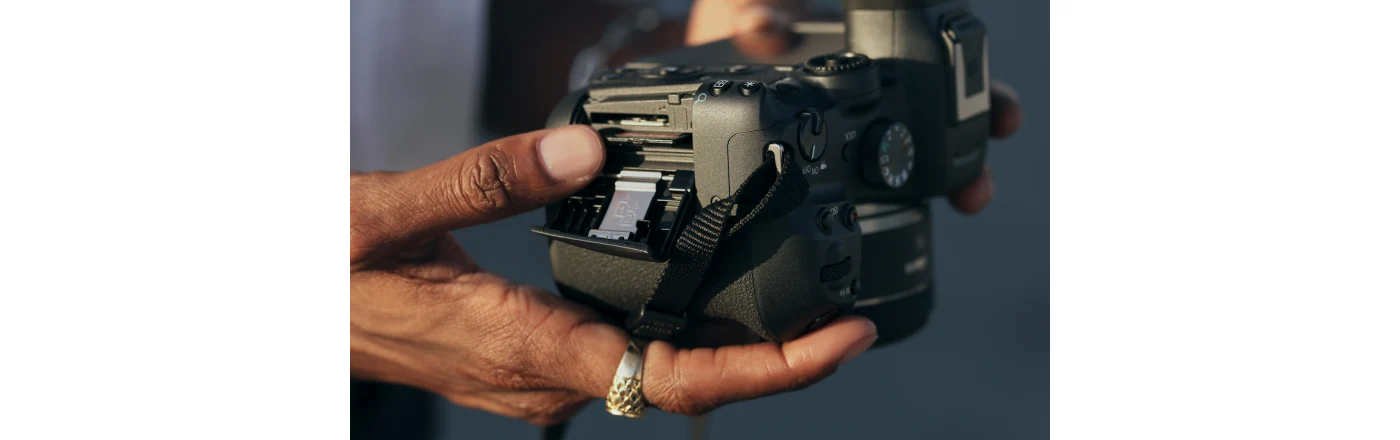
Both card slots support UHS-II SD media. That is convenient for owners who want to standardise their cards and readers, while still requiring attention to the speed demands of each recording mode. Choose media from the manual's requirements rather than from a large capacity number alone. A card that works for ordinary stills may not be the right choice for every video setting or sustained shooting arrangement. Check the exact intended use before buying several matching cards.
Set the recording arrangement explicitly. A second card used for overflow does a different job from one holding a duplicate of the first. Test the chosen arrangement by making files and examining both cards outside the camera. On a used body, inspect the card-door latch and verify that each slot reads and writes reliably. After an assignment, create independent backups before reusing the media. Two slots provide useful choices, but they do not replace a considered storage routine.
Video adds flexibility to an outdoor kit
The R7 offers several 4K modes, and the manual distinguishes frame rates, compression choices and card requirements. Those distinctions matter when a stills photographer wants to add wildlife clips or a creator plans a mixed assignment. Compare the exact mode with the intended lens framing and editing software. A high-quality recording option can produce larger or more demanding files than a simpler mode, and the extra processing may not be necessary for every short clip.
The vari-angle screen and both microphone and headphone connections help with deliberate recording setups. They do not establish sound quality or continuous endurance on their own. Check cable placement, monitor audio and rehearse the intended clip length in representative conditions. We have not measured heat behaviour or stabilization while walking. For an outdoor owner, the useful approach is to add video as a planned workflow, with power and media reserved for it, rather than assume it has no effect on the still-photography day.
Power, weather and inspection of a used body
The R7 uses the larger LP-E6 battery family, with compatibility details that vary by version and function. Identify the supplied battery and the charging method instead of assigning value to an unspecified collection of spares. A pack with an uncertain history can affect confidence in long sessions. Check the compartment, contacts and charge information where available. If the camera will share batteries with another Canon body, verify the exact pairing rather than assuming the familiar shape guarantees identical behaviour.
Outdoor use makes the mount, controls, screen hinge, port covers and card door important inspection points. Ask about moisture exposure and repairs, and inspect the sensor with ordinary test photographs. Environmental resistance is not waterproofing, especially on equipment with an unknown history. Keep the camera dry in storage and follow Canon's cleaning guidance. Canadian and US buyers should confirm the original sales territory and local service terms; an overseas bargain does not automatically include the support arrangement expected from a local authorised purchase.
The support route and the complete-kit verdict
Canon retains a detailed online manual covering the R7's recording, power and interface requirements. Use that model-specific document alongside the current support route when checking firmware. Similar names across EOS R bodies do not make update files or feature descriptions interchangeable. Read the installed version from the camera and follow the official instructions. Documentation available today is useful evidence, but it does not promise that future firmware will add a function missing from the current design.
The strongest R7 purchase is a complete kit aimed at subjects that benefit from its APS-C framing and detailed files. Include lenses, a suitable support arrangement, healthy batteries and dependable SD cards in the calculation. If the body consumes the budget needed for those items, the original attraction can become less practical. If the kit is coherent and the example checks out, the documented design provides a substantial set of tools for deliberate outdoor photography. Its burst figures are part of that toolkit, while successful use still depends on technique and the conditions in front of the lens.
Sources & further reading.
These are the sources behind this research review. Manufacturer claims are not independent performance measurements. Community accounts, when cited, describe individual experiences.
- Canon EOS R7 official overview ↗manufacturer
- Canon EOS R7 manual specifications ↗manual
- Canon R7 and R10 comparison ↗manufacturer
Documentation reviewed: 9 October 2026. Product software and regional bundles can change. Corrections and editorial disclosures.