An editorial assessment of documented capabilities and ownership trade-offs. This is not a hands-on test result or a measurement of reliability.
Features & capability 30%7.9
APS-C stills, subject tracking and useful burst modes cover learning and general action.
Compatibility & connectivity 20%7.8
RF/RF-S and adapted EF options offer growth, with a single media slot and fewer interfaces.
Ownership & upkeep 20%7.5
Standard SD media helps, while small batteries and stabilization choices add ownership decisions.
Setup & everyday use 15%8.3
Compact handling, an articulated screen and integrated flash suit everyday learning.
Documentation & support clarity 15%8.7
A detailed official manual clearly lists crop modes, media and battery requirements.
Compare scores within the same product category. Small decimal differences should not override your needs or the evidence limits.
How the Standpoint Score works
We score five aspects of the documented product on a 0–10 scale, then calculate a weighted total:
- Features & capability30% of the total
- Compatibility & connectivity20% of the total
- Ownership & upkeep20% of the total
- Setup & everyday use15% of the total
- Documentation & support clarity15% of the total
This product’s 8.0/10 is a provisional research assessment. It does not claim measured performance, tested reliability or a verified customer satisfaction rate. Compare it with products in the same category, and read each criterion’s reasoning above.
Read the full rubric and score bands ↗The ownership case.
A credible learning and travel body with useful action-oriented controls. Choose it for a compact, well-matched kit and price the lens stabilization and power requirements honestly.
Reasons to consider it
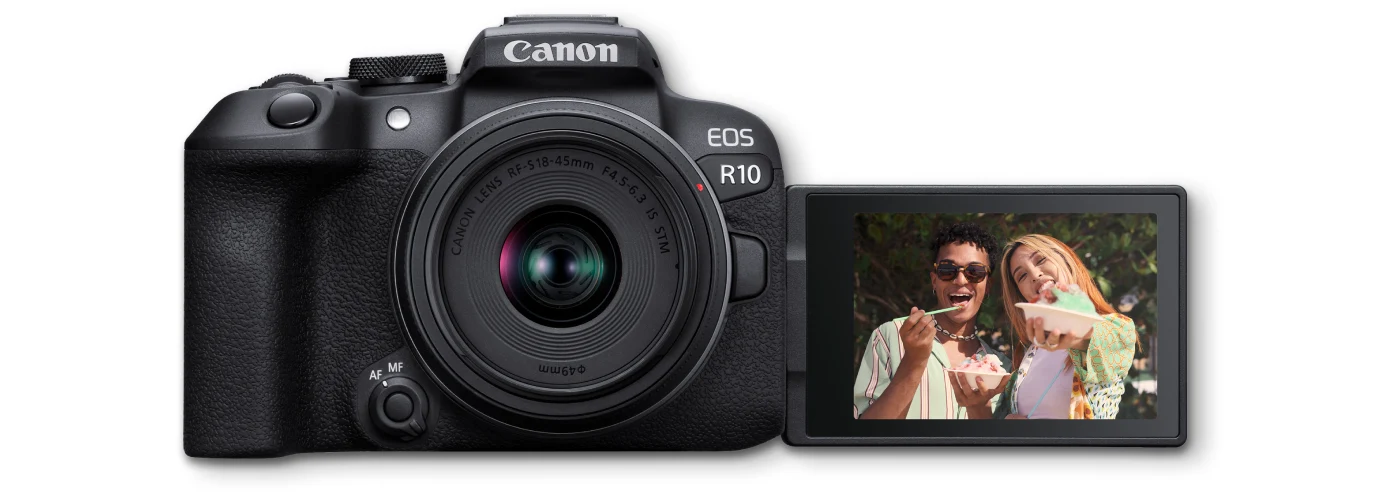
- Compact body with physical controls and a vari-angle screen
- Built-in flash provides an occasional self-contained lighting option
- Native and adapted lens routes support gradual kit development
Go in knowing
- One card slot cannot create an in-camera second-card duplicate
- No in-body sensor-shift stabilization
- 4K60 crop changes the lens framing required for wide scenes
The specification sheet.
Published specifications from the linked sources. Configurations and availability can differ by country.
- Sensor
- 24.2 MP APS-C CMOS
- Mount
- Canon RF/RF-S; compatible EF/EF-S lenses through adapter
- Media
- One UHS-II SD slot
- Maximum continuous shooting
- 15 fps mechanical; up to 23 fps electronic, with conditions
- Video
- 4K up to 30p; cropped 4K up to 60p
- Screen
- 3-inch vari-angle touchscreen; approximately 1.04 million dots
- Battery
- LP-E17
A camera for learning without an oversized kit
The EOS R10 is appealing as a compact camera that leaves room to learn rather than demanding a professional kit immediately. A useful lens, a healthy battery and time spent understanding exposure can make it a more satisfying purchase than a more expensive body used only in unfamiliar automatic modes. Its physical controls and vari-angle screen offer several ways to work, while the APS-C format can help keep an everyday lens kit manageable.
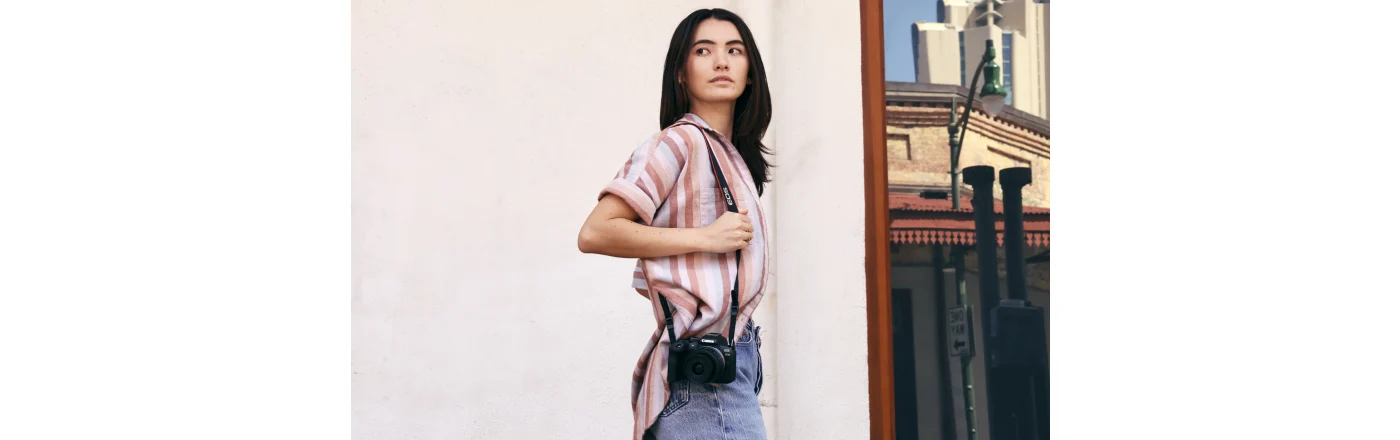
The buying decision should still include the lens attached. A small body paired with a large adapted zoom is a different travel proposition from the camera shown with a compact RF-S lens. Consider the photographs you want to make and the bag you will carry. Our review analyses documented features and their practical consequences; it does not claim measured autofocus accuracy, image quality or battery endurance. For used equipment, the condition and completeness of the specific kit remain central.
The sensor and lens should be chosen together
Canon lists a 24.2-megapixel APS-C sensor. That is a useful resolution for everyday photographs, moderate crops and learning RAW processing, provided the subject is framed and exposed sensibly. A higher-resolution file is not a substitute for a suitable focal length. Indoors, the lens needs to be wide enough for the available space; for distant activity, a longer lens may be more important than spending extra on the body. APS-C framing should be understood before copying a full-frame photographer's lens choices.
The R10 lacks sensor-shift in-body stabilization, making lens stabilization relevant to handheld stills. Check the exact lens rather than assuming every native option provides it. Moving subjects still require suitable shutter speeds even with a stabilized lens. This is a helpful distinction for a learner: steady hands and a stabilized view do not mean a running child will be sharp. Decide whether the problem is camera movement, subject movement or missed focus before buying an accessory intended to solve only one of them.
High burst rates do not remove the need for timing
The published maxima are fifteen frames per second mechanically and twenty-three electronically, under Canon's specified conditions. Those numbers make the R10 interesting for occasional sport and wildlife, but they do not establish how consistently a particular scene will be focused. Lens response, subject contrast, exposure and operator technique remain involved. Use short, intentional sequences and inspect the progression of frames rather than assuming that a larger count produces a better moment.
Electronic shutter use also deserves a scene-specific check, particularly with fast movement or artificial lighting. A quieter mode can be useful without being the preferred choice for every assignment. During a purchase trial, photograph the kinds of movement that matter to you and examine the files on a larger display. Learn a straightforward focus-area fallback for scenes in which automatic subject selection chooses something else. The aim is a repeatable operating routine, not a collection of maximum settings left enabled because they sound impressive.
One card slot changes the recording plan
The R10 has one UHS-II SD slot. That keeps media familiar and the body compact, but it cannot make a second-card duplicate while shooting. A buyer planning irreplaceable assignments should consider that limitation as part of the broader backup and equipment plan. It does not make the camera unsuitable for ordinary use; it means the owner should not mistake UHS-II speed support for the redundancy offered by a two-slot body.
Use media that meets the requirements of the selected recording mode and verify it before a trip. During a used inspection, check the slot, card access and file transfer with a card you trust. After shooting, copy important photographs to independent storage before formatting the card. Avoid building the entire retrieval workflow around wireless transfer to one phone. The R10's simplicity can be an advantage when the owner develops a clear routine, but a single storage location remains a single storage location regardless of the camera's other capabilities.
Cropped 4K60 affects which lens is wide enough
Canon distinguishes ordinary 4K recording up to 30p from cropped 4K at the higher 60p rate. That distinction is especially important for a person filming at arm's length or inside a small room. A lens that frames the scene comfortably in one mode may become too tight in another. Decide which frame rate and output you need before choosing a lens around a demonstration made with different settings. Slow-motion possibilities are useful only if the subject still fits the intended composition.
The vari-angle screen helps with self-framing and unusual camera positions, while the microphone input supports external audio. The body is nevertheless a system to rehearse, not a complete production guarantee. Check the microphone arrangement, recording level, clip length and transfer into the intended editor. We have not measured rolling shutter, heat behaviour or continuous endurance. For short planned clips, the documented tools may be sufficient; for long recurring productions, the untested operating conditions deserve more attention than a headline 4K label.
Flash, battery and daily handling favour preparation
The built-in flash gives the R10 an occasional lighting option without requiring an external unit in every bag. It is useful for learning fill and exposure balance, but its size limits what it can do across a large room or with a lens obstructing the light. Try it at ordinary working distances and examine the result rather than assuming automatic flash is always an improvement. Lighting direction and subject distance matter more than simply whether the flash fired.
The LP-E17 battery supports the compact body, while also making a charging and spare-battery plan sensible for longer days. Published test figures are not a prediction for a day mixing video, wireless transfers and repeated playback. A used pack may have aged substantially. Identify the actual battery and charger, inspect the compartment and verify charging before travel. Set up the camera's controls around a small set of familiar actions so that changing exposure compensation or focus area does not turn into a search through menus at the wrong moment.
Adapted lenses and used condition require exact identification
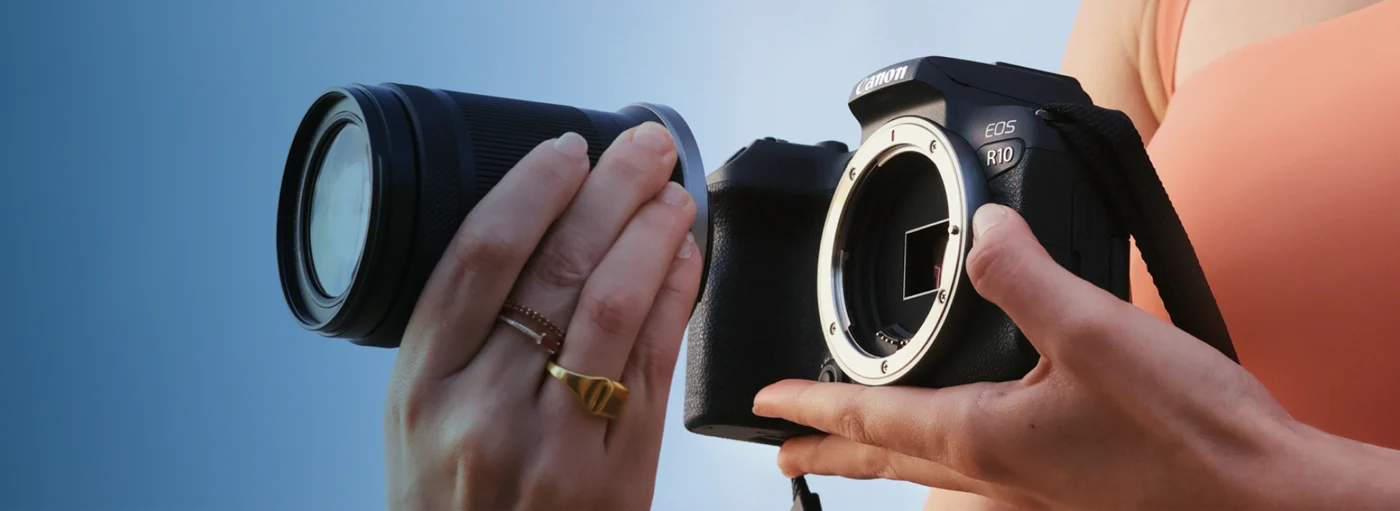
RF and RF-S lenses are native options, while compatible EF and EF-S lenses require the appropriate adapter. EF-M lenses should not be confused with those families. If the purchase depends on reusing a particular lens, check the exact model and demonstrate the combination. The adapter, lens and body together determine balance and behaviour. A favourable price on the R10 may be less compelling if the lens you expected to reuse does not provide the functions or framing needed.
Inspect the mount, screen hinge, flash mechanism, card access and external sockets on a used example. Test the controls and take photographs at several apertures with familiar equipment. Ask about repairs and the original sales territory. Canadian and US buyers should confirm local service arrangements and any remaining coverage rather than assume an imported body receives the same treatment as a local authorised sale. Maintain the camera with careful lens changes, dry storage and the cleaning procedures Canon specifies, rather than improvised cleaning of sensitive internal parts.
The best value is a camera whose compromises fit
The model's online manual remains a useful source for media, power and recording requirements. Compare the installed firmware with the current Canon support route and follow the exact update instructions. Do not borrow firmware or assumptions from another EOS R model merely because the names are similar. Available documentation helps an older camera remain understandable, but it is not a promise that missing hardware functions will arrive later through software.
The R10 is strongest when compactness, learning and general photography matter more than in-camera redundancy or the most elaborate video workflow. Price the complete kit, including any adapter, stabilized lens and dependable spare battery. If those additions erase the saving over a better-matched body, compare again. If the package stays small and coherent, the R10 offers a substantial documented set of controls for developing photographic skill. Its value comes from being a camera you can understand and carry, with clear limitations that fit the job rather than surprise you during it.
Sources & further reading.
These are the sources behind this research review. Manufacturer claims are not independent performance measurements. Community accounts, when cited, describe individual experiences.
- Canon EOS R10 official product page ↗manufacturer
- Canon EOS R10 manual specifications ↗manual
- Canon R7 versus R10 official comparison ↗manufacturer
Documentation reviewed: 9 October 2026. Product software and regional bundles can change. Corrections and editorial disclosures.