The ownership case.
A focused wired option for a quiet listening space. Check the source with the actual recordings and include pad condition and connectors in the purchase; its open cups provide little isolation.
Reasons to consider it
- Detachable cable and replaceable cushions simplify routine upkeep
- Passive listening needs no battery, Bluetooth pairing or companion app
- Independent testing provides useful context for its balanced response and low-bass limit
Go in knowing
- Open cups admit room sound and leak audio to people nearby
- Source suitability depends on available output, not nominal impedance alone
- Used pads, replacement cables and package revisions need inspection
The specification sheet.
Published specifications from the linked sources. Configurations and availability can differ by country.
- Transducer
- 42 mm dynamic, open-back
- Diaphragm
- 38 mm with aluminium voice coil
- Nominal impedance
- 300 Ω (manufacturer rating)
- Frequency response
- 12 Hz – 40,500 Hz (Sennheiser)
- Weight
- 260 g
- Cable
- Current US package: 3 m, 6.3 mm connector with 3.5 mm adapter
- Ear pads
- Velour, replaceable (Sennheiser part, currently listed)
Start with the room, not an amplifier shopping list
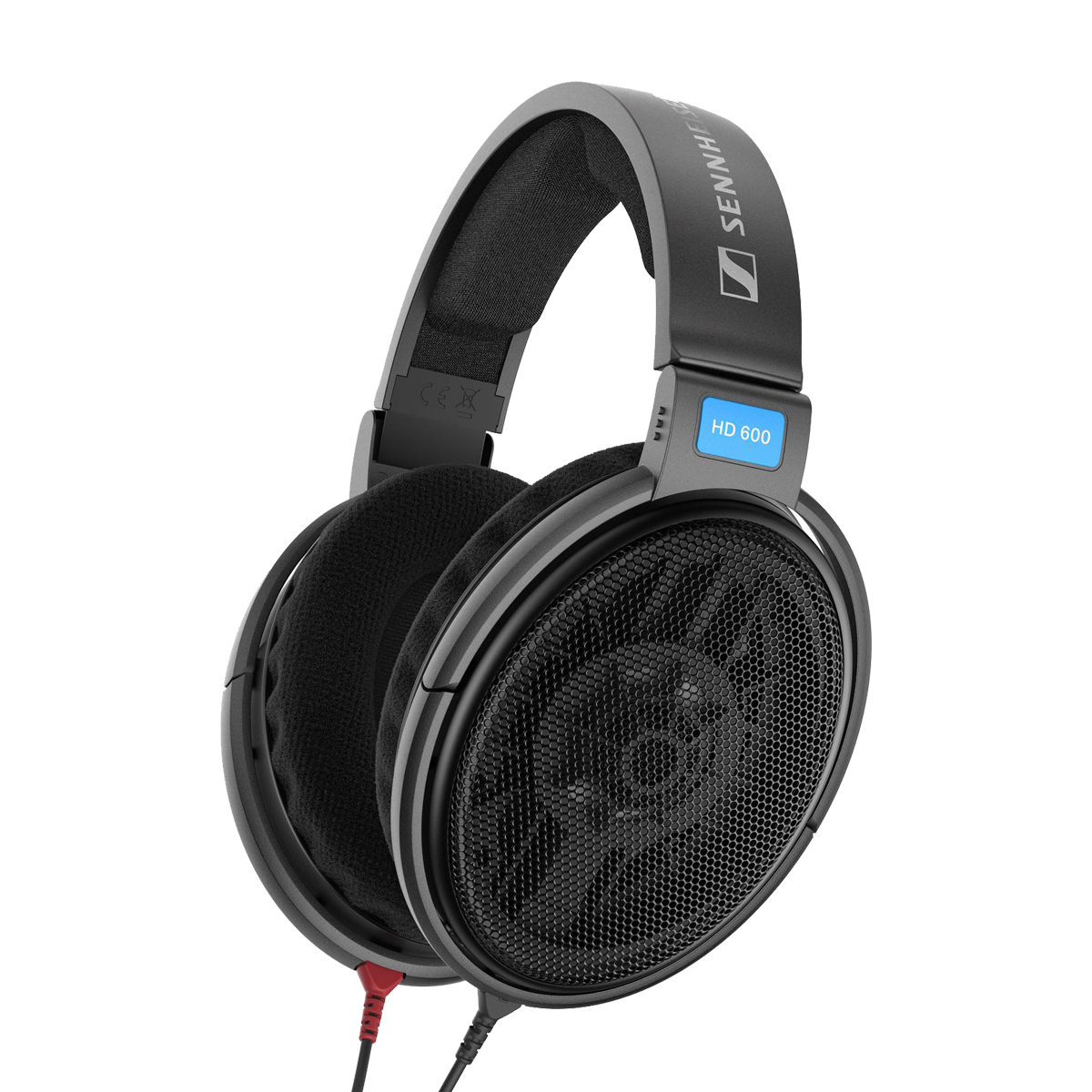
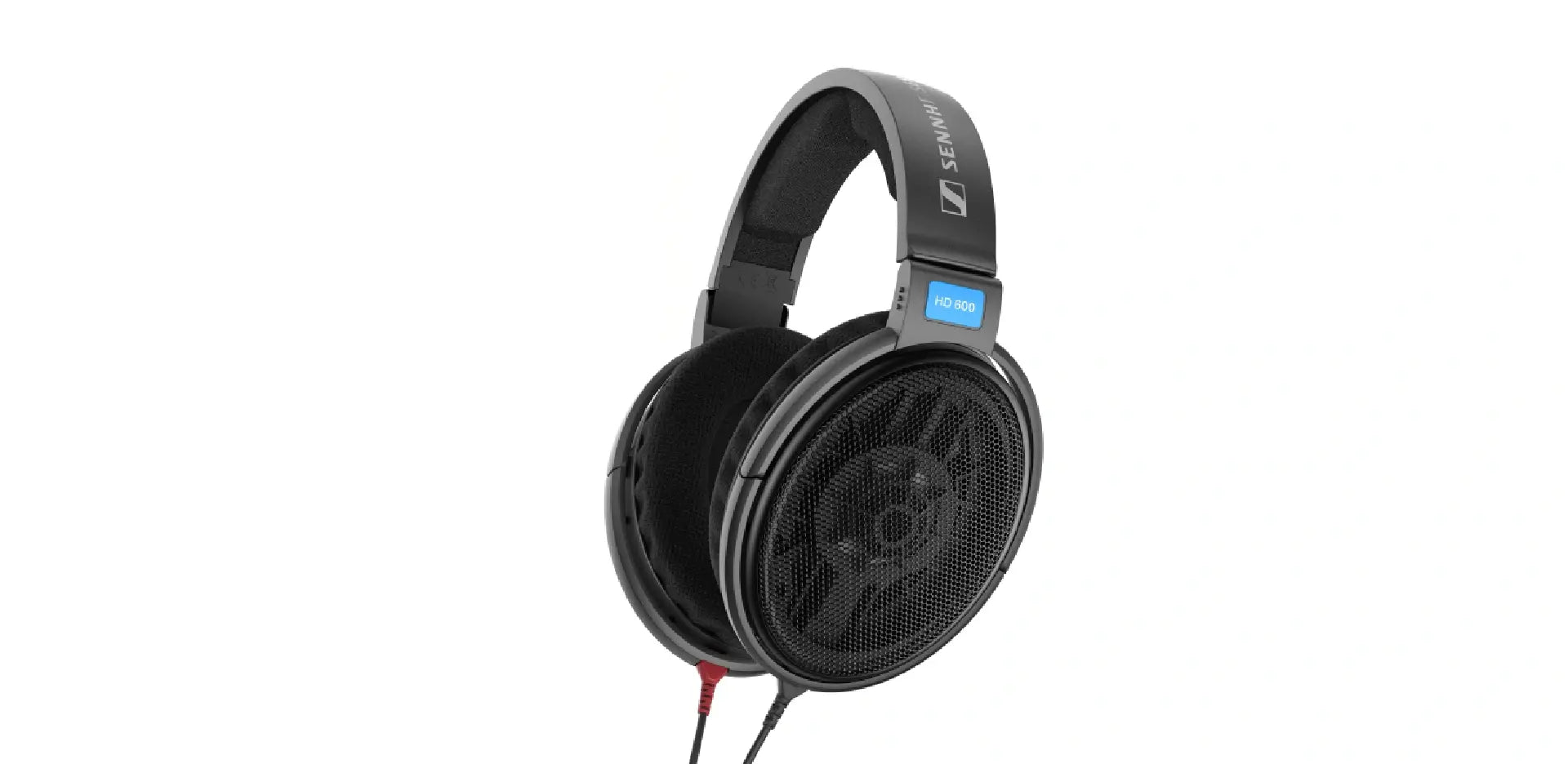
The HD 600 is a passive open-back headphone for deliberate listening. Its cups admit outside sound and let some of the programme escape into the room. That is a physical characteristic of the design, not a setting to disable. Before comparing amplifiers or reading about driver materials, decide whether the usual listening space is quiet enough and whether another person nearby will mind hearing some of the music.
RTINGS’ assessment identifies limited isolation and substantial leakage. It also finds a broadly balanced presentation with reduced low-bass extension. Those are independent results, not measurements by this publication. They help frame the purchase: this is a different tool from a closed wireless headphone designed to suppress a commute. We have not listened to the HD 600 or tested a sample. Its long product history cannot substitute for checking the fit, condition and source of the unit under consideration.
Three hundred ohms does not identify the right source by itself
Sennheiser lists a nominal impedance of 300 ohms. The specification is a useful starting point, but it does not prove that every phone adapter is inadequate or that an expensive desktop amplifier is necessary. Useful output depends on the source’s available voltage, the recording level, the desired listening level and the headphone’s sensitivity. Different published sensitivity figures may use different references or methods; mixing them into a single confident loudness prediction is misleading.
Try the intended output before adding equipment. Listen at a sensible level to both quiet and more demanding passages. If the required level is available without obvious distortion and normal controls offer usable adjustment, the source may already meet the need. If it does not, check a compatible headphone amplifier’s output into a comparable load. A maximum-power figure measured at a very different impedance is not the same test. More output capability is headroom, not a recommendation to listen louder.
Balanced listening does not mean unlimited bass extension
RTINGS describes the response as balanced through much of the range while noting low-bass roll-off. That matters for music built around deep bass and for work where sub-bass decisions are important. A headphone can make voices and instruments useful to follow while still giving an incomplete impression of the lowest frequencies. Do not read the manufacturer’s broad frequency-range endpoints as proof of a flat response between those endpoints; the range does not provide that guarantee.
For editing or mixing, compare familiar material and use another reference where the work demands it. An open-back headphone is not a replacement for checking how a mix translates. EQ can be part of a listening setup, but the chosen adjustment and application must be identified when comparing impressions. Increasing bass can also demand more output headroom. We have not designed or validated an EQ preset for this model, and no preference is presented as an objective correction.
Driver dimensions describe construction rather than a ranking
The current product page lists a 42 mm transducer and a 38 mm diaphragm, with an aluminium voice coil and airflow-control material. Those details describe how Sennheiser built the headphone; they do not independently establish superior detail, timing or soundstage. A driver’s diameter alone is a poor basis for choosing between models. The enclosure, tuning, fit and recording all remain relevant to what a listener hears.
Sennheiser also describes matched drivers and manufacture in Ireland. These are manufacturer statements about the product, not our inspection of a factory or a guarantee that a used pair has never been repaired. Check that both sides play consistently. If a used pair contains a replacement driver, ask who fitted it and what was supplied. A one-sided rattle or drop-out needs investigation rather than a theory about the character of the HD 600 family.
Check the connector on the actual supplied cable
The current US product listing describes a three-metre cable with a 6.3 mm connector and an adapter to 3.5 mm. Older packages and replacement cables may differ. It is therefore safer to inspect the included assembly than assume that every HD 600 ships with the same plug direction or adapter style. The detachable connections at the cups allow cable replacement; they should be seated correctly and handled without pulling on the wire.
A three-metre lead makes sense beside a home system but can leave substantial slack at a desk. Route it away from chair wheels and places where it can snag. If considering an alternative cable, confirm the exact cup connectors and source termination. A balanced plug is not automatically compatible with an ordinary single-ended output, and a connector change does not by itself establish better sound. The first requirement is reliable, correctly wired audio from the equipment already owned.
Pads are an acoustic part as well as a comfort part
Sennheiser describes replaceable velour cushions and modular construction. This is a practical ownership advantage over a design whose cable and contact surfaces cannot easily be renewed. It is not a promise that every spare will remain stocked in every country. Before buying an older pair, check the relevant parts and current regional availability rather than assume a decades-long product history guarantees every future repair.
Inspect how the cushions hold their shape and whether they are original or substituted. Flattened padding changes where the ears sit relative to the drivers and can affect comfort and sound. A review of a fresh sample may therefore differ from an old pair without either reviewer being dishonest. Check the headband padding as well. Replace worn contact parts when appropriate, following the manufacturer’s procedure, rather than assign a fixed sound character to a headphone whose fit has materially changed.
A home-listening fit still needs a personal trial
The listed weight is approximately 260 g. That number does not tell you how the headband pressure feels or whether the cups comfortably surround your ears. Try the adjustment while wearing your normal glasses and keep the headphone on long enough to notice contact points. We have not assessed clamp pressure or long-session comfort. Avoid bending a used frame aggressively to make it fit before deciding whether it is the right size.
The open design also means the room remains audible. For some listeners that is welcome; for others, a fan, television or conversation will interrupt concentration. Raising volume is a poor substitute for choosing an appropriate listening environment. If quiet space is rarely available, compare a closed-back design before spending extra on electronics for this one. The most capable amplifier cannot change the open cups into an isolating enclosure.
There is no microphone or wireless shortcut
The HD 600 provides wired audio and has no built-in microphone, Bluetooth connection or active cancellation. Meetings require a separate microphone, and mobile use requires a suitable wired output. There is no internal battery to charge and no companion app needed for basic operation. Those are attractive simplifications for a fixed listening position, but they should not be confused with all-purpose versatility.
For recording near an open microphone, consider leakage before choosing it as the monitoring headphone. For an office, consider whether colleagues can hear the programme. These are constraints, not claims that using it outside the home is physically impossible. Someone in a quiet private room may find the arrangement straightforward; someone at a noisy shared desk may have to solve problems the HD 600 was never intended to address. Buy for the actual setting.
Compare alternatives on the requirement that changes
The HD 660S2 is another open-back Sennheiser to audition, but its listed impedance is also 300 ohms; it should not be described as a 150-ohm shortcut to easier source matching. Beyerdynamic lists the DT 900 Pro X at 48 ohms. That lower nominal value alone does not establish the preferred sound or fit. Compare both with the intended output and recordings rather than treat one specification as a complete verdict.
A closed-back or wireless alternative changes a different requirement: isolation or mobility. Those may be more valuable than an incremental change between open-back models. Include replacement cushions, the right adapter and any genuinely needed amplifier in the total comparison. We have not completed a listening comparison or category test, so the numerical score remains withheld. The HD 600 is most convincing when a quiet room, suitable output and renewable contact parts match the ownership plan.
Sources & further reading.
These are the sources behind this research review. Manufacturer claims are not independent performance measurements. Community accounts, when cited, describe individual experiences.
- Sennheiser US HD 600 product page — specifications, construction details, spare parts ↗manufacturer
- RTINGS Sennheiser HD 600 review (bought and lab-tested) ↗independent review
- Sennheiser HD 600 instruction manual PDF ↗manual
- Sennheiser HD 660S2 specifications ↗manufacturer
- Beyerdynamic DT 900 Pro X specifications ↗manufacturer
Documentation reviewed: 9 October 2026. Product software and regional bundles can change. Corrections and editorial disclosures.