An editorial assessment of documented capabilities and ownership trade-offs. This is not a hands-on test result or a measurement of reliability.
Task capability 30%8.0
A clear submerged brief covers the common cleaning surfaces.
Navigation & control 20%8.4
Underwater control and multiple retrieval paths are meaningful differentiators.
Ownership & upkeep 20%7.2
Canister care and battery charging remain regular tasks.
Setup & usability 15%7.9
Caddy and controlled lifting address physical handling.
Documentation & support clarity 15%8.2
The current specification explicitly identifies no scheduling and no dirty-canister indicator.
Compare scores within the same product category. Small decimal differences should not override your needs or the evidence limits.
How the Standpoint Score works
We score five aspects of the documented product on a 0–10 scale, then calculate a weighted total:
- Task capability30% of the total
- Navigation & control20% of the total
- Ownership & upkeep20% of the total
- Setup & usability15% of the total
- Documentation & support clarity15% of the total
This product’s 7.9/10 is a provisional research assessment. It does not claim measured performance, tested reliability or a verified customer satisfaction rate. Compare it with products in the same category, and read each criterion’s reasoning above.
Read the full rubric and score bands ↗The ownership case.
Freedom Plus is particularly worth considering when cordless operation and controlled retrieval matter more than recurring schedules or surface skimming.
Reasons to consider it
- LiFi underwater remote
- Several retrieval methods
- Charging caddy included
Go in knowing
- No scheduling in current specification
- No surface skimming
- Remote performance needs pool-specific demonstration
The specification sheet.
Published specifications from the linked sources. Configurations and availability can differ by country.
- Coverage
- Floor, walls and waterline
- Canister
- 4 L
- Scheduling
- No
- Control
- LiFi remote plus iAquaLink functions
Underwater control is the distinctive feature
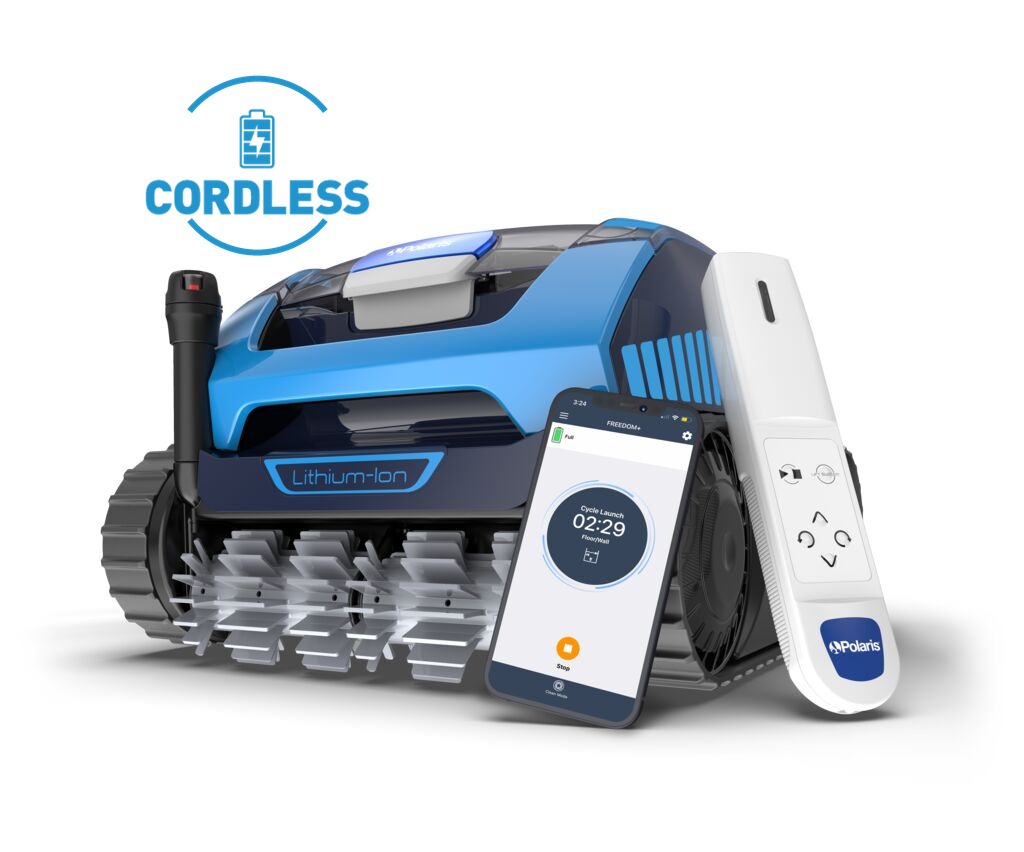
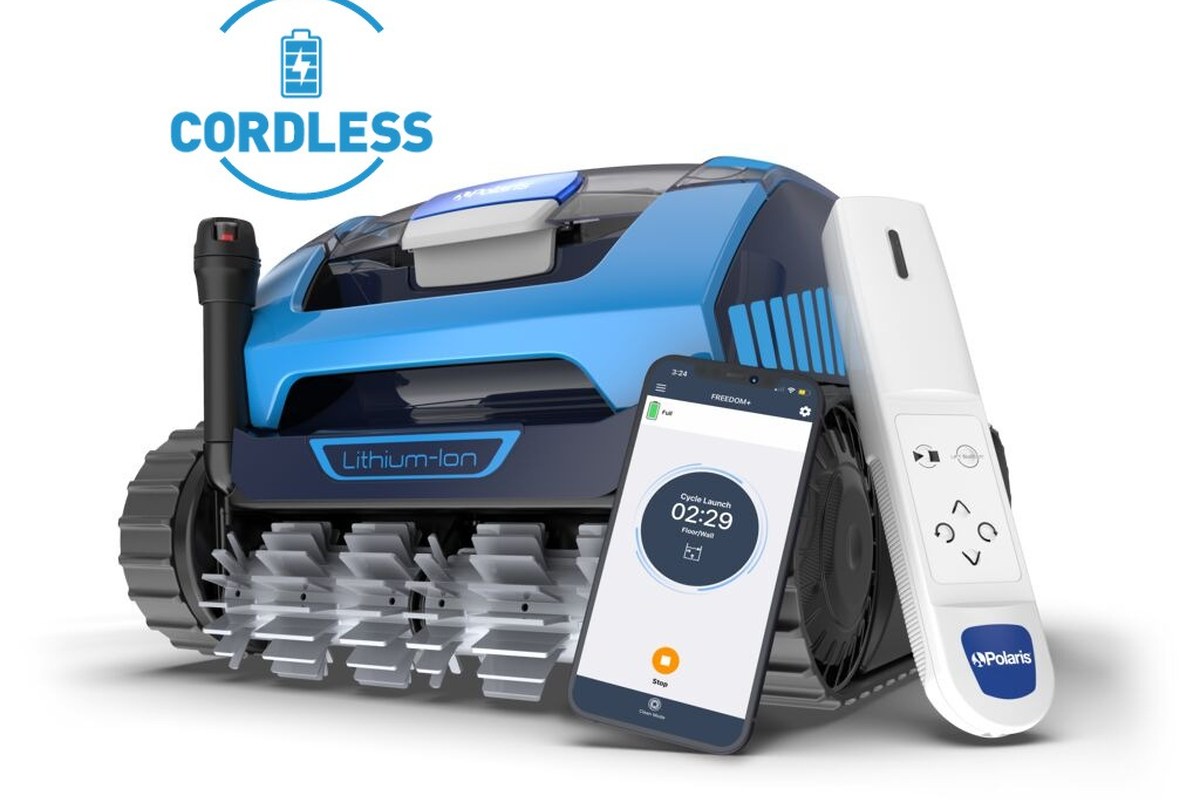
The Freedom Plus is a cordless pool cleaner whose most interesting feature is its handheld underwater-control system. Polaris describes LiFi communication that can direct movement and trigger retrieval while the robot is submerged. That is a different proposition from a phone app that only connects when a cleaner is on the deck or surface. The machine also includes a charging caddy and covers floor, walls and waterline. It does not skim floating debris, and the current specification table explicitly lists no scheduling. Those boundaries are useful because they make the buying decision more concrete. The Freedom Plus is aimed at an owner who wants cordless cleaning with deliberate control and retrieval, not necessarily unattended recurring operation over many days.
LiFi should be demonstrated in your conditions
A specialised underwater remote can solve a real problem: calling a robot back before its cycle finishes or directing it around a missed area. The practical range, aiming requirements and reliability in different water conditions deserve a demonstration. Do not assume that a successful command in shallow clear water proves equal behaviour across a deep, complex pool. Test from the place where you normally stand, with the robot near the farthest wall. Keep the remote's care and battery requirements in mind as well. A separate controller is useful when it offers dependable physical access, but it becomes another item to store. The owner should also understand the fallback retrieval process when the remote is unavailable.
The retrieval system has alternatives
Polaris describes Easy Lift, a tap-triggered lift function and other collection methods. Redundancy is welcome because retrieval is a task that must succeed at the end of every run. The real ergonomic question is whether the robot reaches an accessible waterline position and drains sufficiently before the owner lifts it. A feature name cannot answer that for a raised pool wall or a narrow opening between landscaping. Try the complete process with the basket wet and loaded, including the carry to the caddy. Do not mistake reduced retained water for a weightless machine. For someone with limited strength or reach, a dealer demonstration of this one task may be more valuable than a comparison of several cleaning specifications.
Four modes without a recurring schedule
The Freedom Plus offers floor, combined coverage, waterline and a calculated Smart cycle through its available controls. Those modes let the owner tailor an individual session, but the absence of scheduling means it should not be purchased on the assumption that it will automatically start a recurring weekly plan. This is not inherently a flaw. Many owners prefer to deploy a cleaner when the pool is clear of swimmers, then remove and clean it afterward. It does mean the robot's autonomy has a defined scope. App connectivity can provide status and configuration while still leaving the initiation and maintenance routine in human hands. Ask the dealer to demonstrate precisely which functions operate on the robot, remote and app.
Cleaning performance remains a separate test
A sophisticated retrieval and control system does not by itself establish superior dirt removal. The Freedom Plus still needs productive brush contact, sufficient water flow through its filter and coverage of the actual pool geometry. Inspect the waterline, deep-end transitions, corners and areas around fittings after a full run. A four-litre canister can hold a useful amount of debris, but fine sediment may affect filtration before the canister is visibly full. The transparent lid offers a convenient visual check; the source lists no dirty-canister indicator, so observation and routine maintenance remain important. We have not measured pickup, wall coverage or the effect of filter loading and do not convert the feature list into an unsupported cleaning score.
The caddy is part of the appliance
Including a charging caddy can improve everyday ownership by providing storage, transport and charging in one place. Its usefulness depends on the route to the pool. A smooth patio is different from gravel, stairs or a narrow gate. Check whether the caddy fits the storage area and whether the robot can be placed on it without an awkward lift. Polaris specifies a suitable protected electrical connection for charging; plan the location accordingly. The advertised recharge interval also matters if another cleaning session is needed later the same day. A caddy simplifies the battery routine, but it does not eliminate it. Owners who frequently require consecutive runs should compare that rhythm with corded alternatives.
Connectivity should be judged by useful information
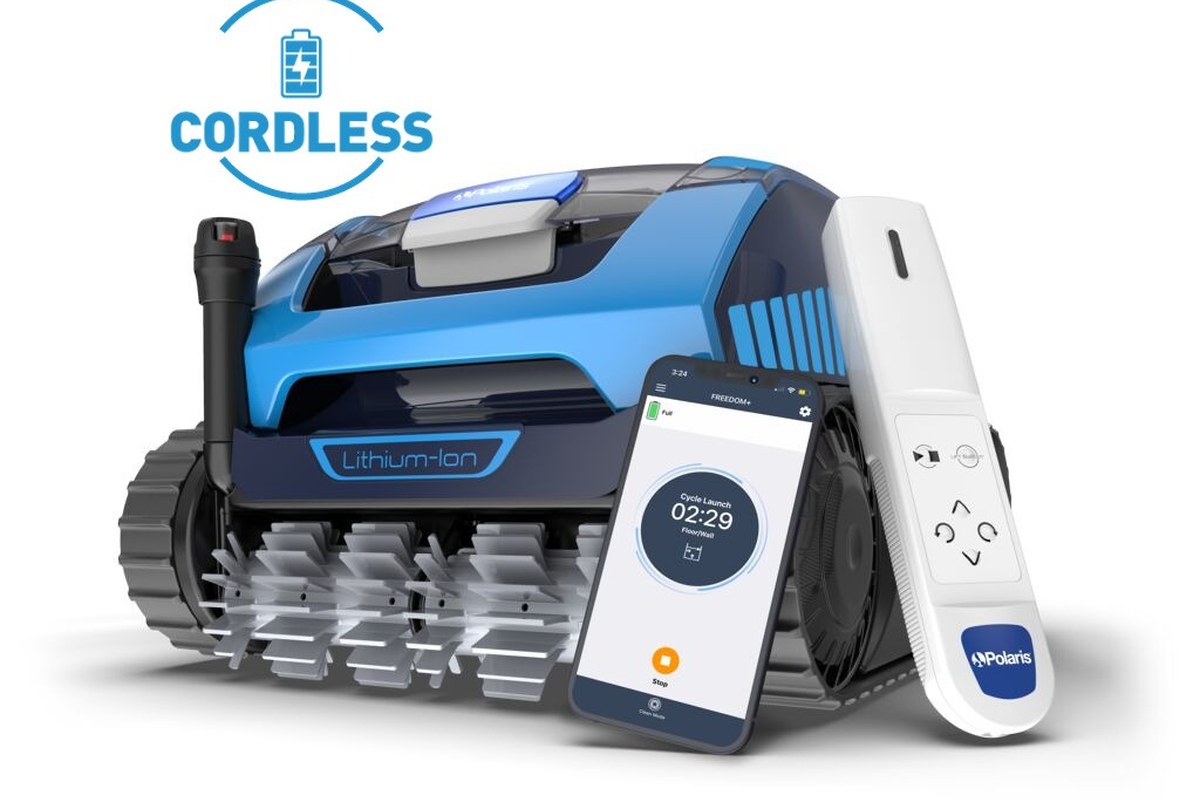
The iAquaLink connection provides status and mode-related functions, but the underwater remote is a separate control path. Keeping those roles distinct avoids unrealistic expectations about phone steering. Check wireless coverage at the charging location and clarify what notifications arrive after a cycle. Consider whether the household needs shared access and how account transfer works if the machine is sold. We have not audited the app's privacy or security practices. Record firmware and app versions when reporting a problem, and keep a simple log of the conditions under which it occurs. Good troubleshooting information is especially useful for a robot with several interfaces, because a missed command, poor connectivity and a mechanical issue can look similar from the pool edge.
Dealer support can be a material advantage
Polaris's dealer-oriented sales route gives buyers an opportunity to discuss the pool and service before committing. Use that opportunity. Ask which parts are stocked locally, whether the cleaner can be demonstrated and how battery, charger or drivetrain faults are handled. A dealer relationship is valuable only when the actual local support is useful; the brand's existence alone does not guarantee a particular turnaround. Confirm the warranty and return terms for the seller and region. We have not established a representative reliability record for the Freedom Plus. The purchase case should therefore include a concrete repair route and realistic maintenance expectations, rather than resting on a general reputation for professional pool equipment.
Our research verdict
Freedom Plus is particularly worth considering when cordless operation and controlled retrieval matter more than recurring schedules or surface skimming. The handheld underwater link is a meaningful differentiator if it works reliably in the buyer's pool. That remains unverified here. A strong trial would include remote commands at different distances, interrupted cycles, tap retrieval, loaded-filter cleaning and transport on the actual route to storage. It would also document any missed wall or waterline areas. The machine's design is coherent and unusually clear about how an owner interacts with it. Its suitability should be decided through those practical demonstrations, with the explicit lack of scheduling treated as a purchase boundary rather than discovered after delivery.
Sources & further reading.
These are the sources behind this research review. Manufacturer claims are not independent performance measurements. Community accounts, when cited, describe individual experiences.
- Polaris Freedom Plus — official product information ↗manufacturer
- Polaris Freedom Plus owner manual ↗manual
Documentation reviewed: 9 October 2026. Product software and regional bundles can change. Corrections and editorial disclosures.