An editorial assessment of documented capabilities and ownership trade-offs. This is not a hands-on test result or a measurement of reliability.
Task capability 30%8.2
Documented scheduling sensor and accessory capabilities cover substantial HVAC needs
Control & connectivity 20%8.0
Matter adds control routes while Google Home retains setup responsibility
Ownership & upkeep 20%7.5
Account management sensor power and regional services need attention
Setup & usability 15%7.8
Physical interface and supplied sensor help but equipment compatibility is essential
Documentation & support clarity 15%8.5
Google provides detailed generation-specific technical and compatibility references
Compare scores within the same product category. Small decimal differences should not override your needs or the evidence limits.
How the Standpoint Score works
We score five aspects of the documented product on a 0–10 scale, then calculate a weighted total:
- Task capability30% of the total
- Control & connectivity20% of the total
- Ownership & upkeep20% of the total
- Setup & usability15% of the total
- Documentation & support clarity15% of the total
This product’s 8.0/10 is a provisional research assessment. It does not claim measured performance, tested reliability or a verified customer satisfaction rate. Compare it with products in the same category, and read each criterion’s reasoning above.
Read the full rubric and score bands ↗The ownership case.
Nest Learning Thermostat fourth generation is a strong candidate for a compatible home that values an approachable circular interface and is comfortable using Google Home for setup and advanced management.
Reasons to consider it
- Included second-generation temperature sensor
- Circular display with Dynamic Farsight
- Matter support broadens everyday control
Go in knowing
- Google Home is required for installation
- Some systems still need additional power provision
- Learning and energy features depend on household patterns and regional services
The specification sheet.
Published specifications from the linked sources. Configurations and availability can differ by country.
- HVAC class
- Most compatible 24V systems
- Display
- 2.68-inch circular 600 x 600 LCD
- Wi-Fi
- 2.4/5GHz 802.11n
- Included sensor
- One Nest Temperature Sensor second generation
- Setup
- Google Home required
- Published warranty
- Two years retail or five years through HVAC Pros subject to terms
The thermostat that asks to learn
Google Nest Learning Thermostat in its fourth generation is appealing to someone who wants the thermostat to become less noticeable in daily life. The premise is that preferences and routines can inform scheduling, while a redesigned circular display makes the remaining interactions clearer. The relevant question is whether a particular household has patterns worth learning and whether its occupants welcome automatic adjustments. A regular commute and a consistent bedtime present a different problem from rotating shifts, guests and rooms used unpredictably. This research review covers the documented fourth-generation model, including its supplied temperature sensor and Google Home setup requirements. We have not installed it, measured temperature control or tested its learning behavior through seasonal changes. Those are essential limits when interpreting a device marketed around adapting to real life.
A display is part of the interface
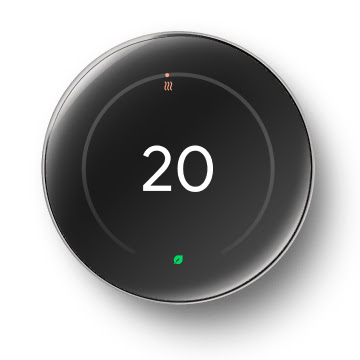
Google specifies a 2.68-inch circular LCD at 600 by 600 pixels, with motion, temperature, humidity and ambient-light sensing. Dynamic Farsight presents selected information from a distance. Those features make sense for a thermostat positioned along a frequently used route, where checking the temperature should not require opening an app. They may matter less in a tucked-away utility corridor. We would evaluate legibility from the actual viewing angle and lighting conditions, including whether reflections compete with the displayed information. The finish is a preference, but the interface is a household tool. A visitor should be able to make an ordinary adjustment confidently, and the owner should understand whether that adjustment affects a temporary hold or the learned routine. Attractive hardware cannot compensate for unclear control behavior.
Compatibility is more specific than a system percentage
The official technical reference describes broad 24V HVAC compatibility and includes accessory connections for supported ventilation, humidification and dehumidification arrangements. Exact wiring and equipment remain decisive. Canadian electric baseboard installations using line voltage are a separate category, and complex systems deserve professional assessment before purchase. Google says its power-sharing design works without a C wire in most homes, while also acknowledging cases that need additional power provision. We would therefore use the compatibility checker and resolve power requirements rather than treating the broad claim as a guarantee. The included trim and mounting plates may simplify the visible finish, but they do not establish electrical suitability. A successful installation begins with identifying what the existing thermostat controls and preserving the equipment's required behavior.
What the included sensor can change
One second-generation Nest Temperature Sensor comes in the package, with support for additional sensors. That gives buyers a practical way to observe a room that differs from the hallway. The useful question is how that information should influence the system at different times. If the bedroom is the priority overnight, other rooms may follow a different comfort compromise. A sensor cannot independently open a nonexistent heating zone or fix an airflow problem. We would compare occupied-room comfort before adding more sensors and avoid placing the first one where sunlight or a nearby heat source dominates its reading. The package's inclusion is valuable because it encourages a more relevant measurement point, but the owner must still decide whether the home needs a control adjustment or a physical building improvement.
Learning should remain understandable
Automatic scheduling is most useful when its decisions are legible to the people affected. We would start by observing what the thermostat proposes and how easily a resident can correct it, rather than assuming that fewer manual actions always indicate better control. A home may be empty for an unusual day, or someone may be ill and need a different temperature; those exceptions should not create weeks of unwanted behavior. Google's documented energy features include scheduling and adjustments based on changing conditions, but no brochure can predict the preferred balance for a specific family. A careful evaluation would distinguish a useful suggestion from a change that surprises someone. The owner should retain a clear route to a predictable schedule whenever adaptation creates more explanation than convenience.
Matter does not remove Google Home
The fourth-generation Learning Thermostat is Matter-certified, and Google's documentation says it can be controlled through other compatible apps and assistants. Google Home is still required for installation and setup. That distinction prevents a common buying mistake: cross-platform control is not the same as being independent of the manufacturer's onboarding path. We would confirm which everyday controls appear in the intended second ecosystem and expect advanced configuration to require the original app unless documented otherwise. Account ownership deserves attention in shared or rented homes, especially when a property changes occupants. The practical test is whether everyone can perform the actions they need without sharing administrator credentials. A supported connection to several platforms is helpful only when it reduces friction rather than multiplying conflicting schedules and duplicate device entries.
Energy, ventilation and regional services
The product page describes adaptive energy features, system-health notifications and smart ventilation. Their usefulness depends on the connected equipment, available information and local services. A thermostat cannot introduce fresh air through hardware the home does not have, and an alert is not a complete diagnosis of an HVAC fault. US energy programs and promotional savings should not be carried over automatically to Canadian buyers; eligibility, tariffs and service availability need local verification. We would assess energy use over comparable weather and occupancy rather than compare two arbitrary bills. Comfort complaints also belong in the record, because reducing runtime by making occupied rooms unpleasant is not a successful outcome. The strongest financial case is a documented opportunity to improve the current routine, not an assumption that a newer thermostat necessarily pays for itself.
Ownership after the first season
Google's technical page lists a two-year standard retail warranty and a five-year standard warranty for HVAC Pro purchases, subject to the applicable terms. Buyers should confirm the actual sales channel and regional coverage. Long-term ownership includes retaining installation information, maintaining sensor power, keeping household access current and understanding operation during a network disruption. Our future test would log control behavior through ordinary schedule changes, deliberate exceptions and changing outdoor conditions. We would check whether sensor selection produces the intended compromise and whether notifications make clear what the owner should do next. We would also assess recovery after a router change and the ease of handing the system to another resident. Those administrative details can be more consequential over years than a small difference in display size or finish.
Our research verdict
Nest Learning Thermostat fourth generation is a strong candidate for a compatible home that values an approachable circular interface and is comfortable using Google Home for setup and advanced management. The included temperature sensor strengthens the package, while Matter gives the owner more options for everyday control. Its value is less certain for a household whose routines are highly irregular or whose existing thermostat already meets a carefully tuned comfort plan. We would buy after verifying wiring, power and regional service assumptions, then judge the learning features by whether they reduce work without creating surprises. The provisional score reflects documented capability and the clarity of the technical reference. It does not claim proven bill savings, flawless learning or superior temperature accuracy over a competing thermostat we have not tested alongside it.
Sources & further reading.
These are the sources behind this research review. Manufacturer claims are not independent performance measurements. Community accounts, when cited, describe individual experiences.
- Google Nest Learning Thermostat (4th gen) — official product information ↗manufacturer
- Google Nest thermostat technical specifications ↗support
Documentation reviewed: 9 October 2026. Product software and regional bundles can change. Corrections and editorial disclosures.