An editorial assessment of documented capabilities and ownership trade-offs. This is not a hands-on test result or a measurement of reliability.
Features & capability 30%8.2
ProMotion, telephoto, macro and advanced formats offer meaningful specialist capability.
Compatibility & connectivity 20%7.5
5G and MagSafe are useful, while Lightning complicates larger-file workflows.
Ownership & upkeep 20%6.5
Multiple premium components and heavy file usage raise maintenance and storage considerations.
Setup & everyday use 15%7.8
The smaller Pro size balances working area with portability, though the body is relatively weighty.
Documentation & support clarity 15%8.8
Official documentation explicitly states the storage-dependent ProRes limitation.
Compare scores within the same product category. Small decimal differences should not override your needs or the evidence limits.
How the Standpoint Score works
We score five aspects of the documented product on a 0–10 scale, then calculate a weighted total:
- Features & capability30% of the total
- Compatibility & connectivity20% of the total
- Ownership & upkeep20% of the total
- Setup & everyday use15% of the total
- Documentation & support clarity15% of the total
This product’s 7.8/10 is a provisional research assessment. It does not claim measured performance, tested reliability or a verified customer satisfaction rate. Compare it with products in the same category, and read each criterion’s reasoning above.
Read the full rubric and score bands ↗The ownership case.
A focused option for buyers who will use its display and camera advantages. Check all cameras, the panel and the exact storage configuration before valuing its professional recording features.
Reasons to consider it
- Adaptive ProMotion display
- Separate telephoto and close-focus options
- ProRAW and ProRes workflows
Go in knowing
- 128 GB ProRes restriction is material
- Large creative files need a transfer plan
- Used OLED and camera condition can be costly compromises
The specification sheet.
Published specifications from the linked sources. Configurations and availability can differ by country.
- Display
- 6.1-inch OLED; adaptive refresh up to 120 Hz
- Processor
- A15 Bionic; five-core GPU
- Cameras
- Three 12 MP cameras; 3× telephoto and macro capability
- Storage
- 128 GB, 256 GB, 512 GB or 1 TB
- ProRes limit
- Up to 4K/30; 128 GB configuration limited to 1080p/30
- Weight
- 204 g
Start with the feature that earns the Pro premium
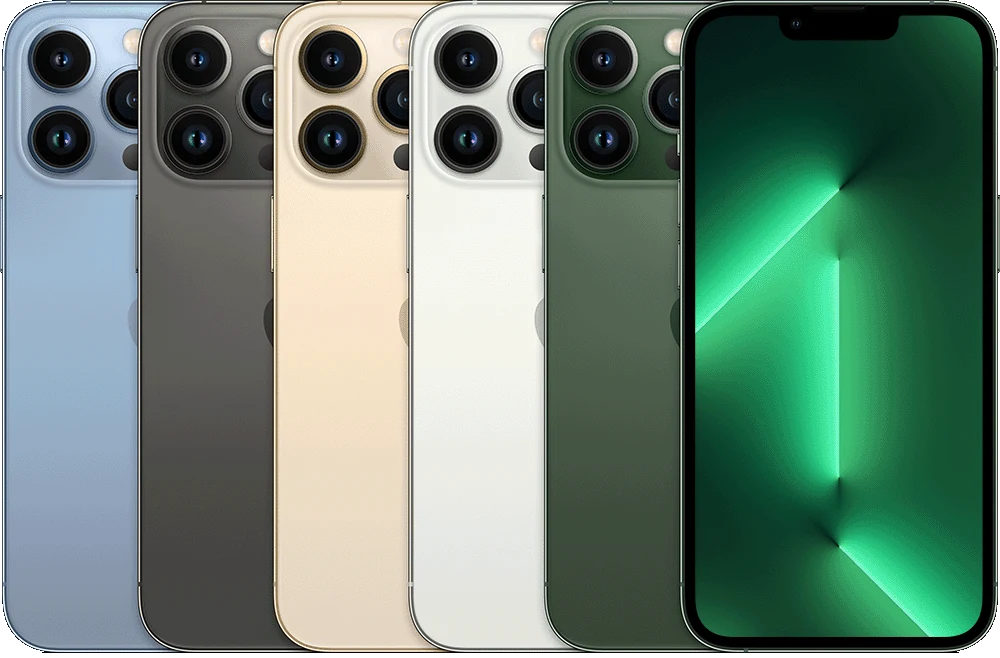
The iPhone 13 Pro has several identifiable reasons to choose it over an ordinary older iPhone: a display with adaptive refresh, a separate telephoto camera and close-focus photography options. Those are more persuasive than the badge. A buyer who regularly uses one or more of them has a rational comparison to make. Someone who mostly messages, browses and takes occasional wide photographs may gain less from accepting the repair risks of an older premium model.
Our review treats the 13 Pro as a set of creative and everyday tools. It does not assume that its original price proves current superiority, nor that a used example matches a launch demonstration. The aim is to identify the capabilities worth paying for and the configuration details that could frustrate their use. Condition, storage and workflow belong in that discussion from the beginning.
ProMotion is an interaction feature
Apple specifies adaptive refresh up to 120 Hz on the 6.1-inch OLED. The practical attraction is how the interface and supported content can move, not a promise that every application constantly runs at the maximum rate. Try scrolling the material you read and using the applications you keep open for long periods. Decide whether the difference matters to you before assigning a premium to it.
For a refurbished unit, the display must first be healthy. Inspect neutral colours, low brightness and touch response across the surface. A replacement panel warrants questions about what was installed and whether its behavior matches the expected features. The ProMotion specification is of little value if the actual screen is compromised. The body also deserves a handling trial: its listed weight is substantial enough that the smaller screen size should not be mistaken for an especially light phone.
The telephoto is useful at a particular distance
The dedicated 3× telephoto provides a different framing option from the main camera. That can help isolate a portrait, a detail on a building or a subject that cannot conveniently be approached. It should not be interpreted as unlimited optical reach. Think about the distances involved in your actual photography, and compare examples at those distances rather than relying on a maximum digital-zoom figure.
Inspect the telephoto separately from the main and ultrawide cameras. Take a detailed subject in good light, then an indoor scene relevant to your use. Review the saved files for focus or stabilization faults. A seller's single attractive image is insufficient evidence for a three-camera device. Our provisional score recognizes the extra compositional option, while withholding claims about measured image quality, low-light consistency or the condition of a particular repaired module.
Macro invites a different style of photography
Close-focus capability is one of this model's more interesting distinctions for someone documenting small objects, craft work or textures. It changes the kinds of subjects that are convenient to record. The useful question is whether the result reveals the details you actually need. A collector photographing condition, for example, may care more about consistent focus and lighting than a dramatic-looking close-up.
Try an object with fine detail and examine how easily you can position the phone without blocking the light. Check the edges of the image and make sure the desired part of the subject is sharp. This is also a useful inspection of the relevant camera hardware. Close photography can expose a damaged lens cover or focus problem that a distant landscape hides. The feature is worthwhile when it supports repeatable documentation, rather than simply adding another mode to explore once.
ProRes has a configuration trap
Apple explicitly distinguishes the ProRes capability of the 128 GB configuration: it is limited to 1080p at 30 frames per second, while higher capacities support the listed 4K option. That is a material buying detail for someone choosing the 13 Pro for video. Two listings with the same model name are therefore not equivalent for that particular workflow. Verify the actual capacity on the device before payment.
Even with the appropriate configuration, establish why you need the format. Larger production-oriented files require storage, transfer time and a compatible editor. Record a short sample and complete an editing round trip before treating the phone as equipment for an important job. If the final output is a quick message to relatives, a simpler recording setting may be more convenient. The feature's value lies in the flexibility you use, not the file size you create.
Creative storage needs a routine behind it
The range extends to 1 TB, but buying the largest capacity is not a substitute for organizing and backing up work. Decide how photographs and clips will move off the phone, where they will be stored and how you will locate them later. A large local library can make a phone feel self-sufficient while increasing the consequences of loss or failure. A reliable routine matters more than simply postponing the day the storage fills.
Lightning is the wired connection on this generation. Test the intended cable and transfer process with representative files, particularly if video is central to the purchase. Wireless sharing can be convenient in some setups, but it should be evaluated against the actual volume of material. Consider the computer, storage and subscriptions as part of the overall cost. A discounted creative phone is less attractive if the supporting workflow requires unexpected spending or constant manual intervention.
Inspect ownership essentials as carefully as the cameras
The premium features do not make ordinary checks less important. Confirm that Face ID works, the previous account has been removed and normal activation completes. Make a call, record speech and test both wired and intended wireless charging. Request battery and repair information, including details of any screen or camera replacement. A technically impressive phone with unresolved basic faults is an inconvenient thing to rely on.
Check the exact regional model against the intended carrier and verify current software and app requirements. The A15 generation does not guarantee indefinite compatibility, and an employer's device policy may be narrower than a consumer app's requirements. Obtain a current battery-service quote if the example is likely to need attention. Written return terms should be part of the decision, since a short inspection cannot reproduce every connection, camera and charging situation encountered in normal life.
A worthwhile older Pro for a defined workflow
The 13 Pro is most compelling when the buyer can name the feature that makes it preferable: smoother supported interaction, a telephoto perspective, close-focus work or a specific editing format. In that situation, the product has a clearer purpose than an ordinary older phone. It is less convincing when those capabilities remain hypothetical and the buyer mainly wants the prestige of a former flagship.
Our research verdict favors a documented, healthy configuration over the cheapest listing. Compare the total after battery work, accessories and storage requirements, then consider whether a newer alternative would simplify the same task. No measured endurance or camera ranking is implied by the score. The model's documented strengths are substantial; the buying discipline is to confirm that the actual device, and the workflow around it, allow those strengths to be used without expensive surprises.
Sources & further reading.
These are the sources behind this research review. Manufacturer claims are not independent performance measurements. Community accounts, when cited, describe individual experiences.
Documentation reviewed: 9 October 2026. Product software and regional bundles can change. Corrections and editorial disclosures.