An editorial assessment of documented capabilities and ownership trade-offs. This is not a hands-on test result or a measurement of reliability.
Task capability 30%8.0
Generous everyday print volume, constrained by an open frame and material guidance.
Control & connectivity 20%8.2
Cloud and documented LAN-only options; monitoring camera has limited frame rate.
Ownership & upkeep 20%7.6
Accessible nozzle changes, but recall verification matters for older used units.
Setup & usability 15%8.8
Automatic calibration removes several novice adjustments; moving-bed clearance still needs planning.
Documentation & support clarity 15%8.6
Detailed product FAQ, quick-start documentation and explicit recall record support informed ownership.
Compare scores within the same product category. Small decimal differences should not override your needs or the evidence limits.
How the Standpoint Score works
We score five aspects of the documented product on a 0–10 scale, then calculate a weighted total:
- Task capability30% of the total
- Control & connectivity20% of the total
- Ownership & upkeep20% of the total
- Setup & usability15% of the total
- Documentation & support clarity15% of the total
This product’s 8.2/10 is a provisional research assessment. It does not claim measured performance, tested reliability or a verified customer satisfaction rate. Compare it with products in the same category, and read each criterion’s reasoning above.
Read the full rubric and score bands ↗The ownership case.
A strong research shortlist choice for PLA and PETG projects, with useful automated setup and clear material restrictions. Check recall status carefully when buying an older used unit.
Reasons to consider it
- Automatic bed and flow calibration reduce initial tuning
- 256 mm build cube and readily changed nozzle
- Current manufacturer documentation includes LAN-only operation and accessory compatibility
Go in knowing
- Open-frame machine; Bambu does not recommend enclosing it
- Original 2024 units were recalled for a heatbed cable issue
- AMS lite is optional on the standalone model and adds space and purge waste
The specification sheet.
Published specifications from the linked sources. Configurations and availability can differ by country.
- Build volume
- 256 × 256 × 256 mm
- Nozzle / bed limits
- 300°C / 100°C
- Motion specification
- Up to 500 mm/s; 10,000 mm/s² acceleration
- Included nozzle
- 0.4 mm stainless steel
- Best documented materials
- PLA, PETG, TPU and PVA; feed-system restrictions apply
- Multicolor
- AMS lite in Combo; other AMS types require the specified hub
A capable starting point with a defined job
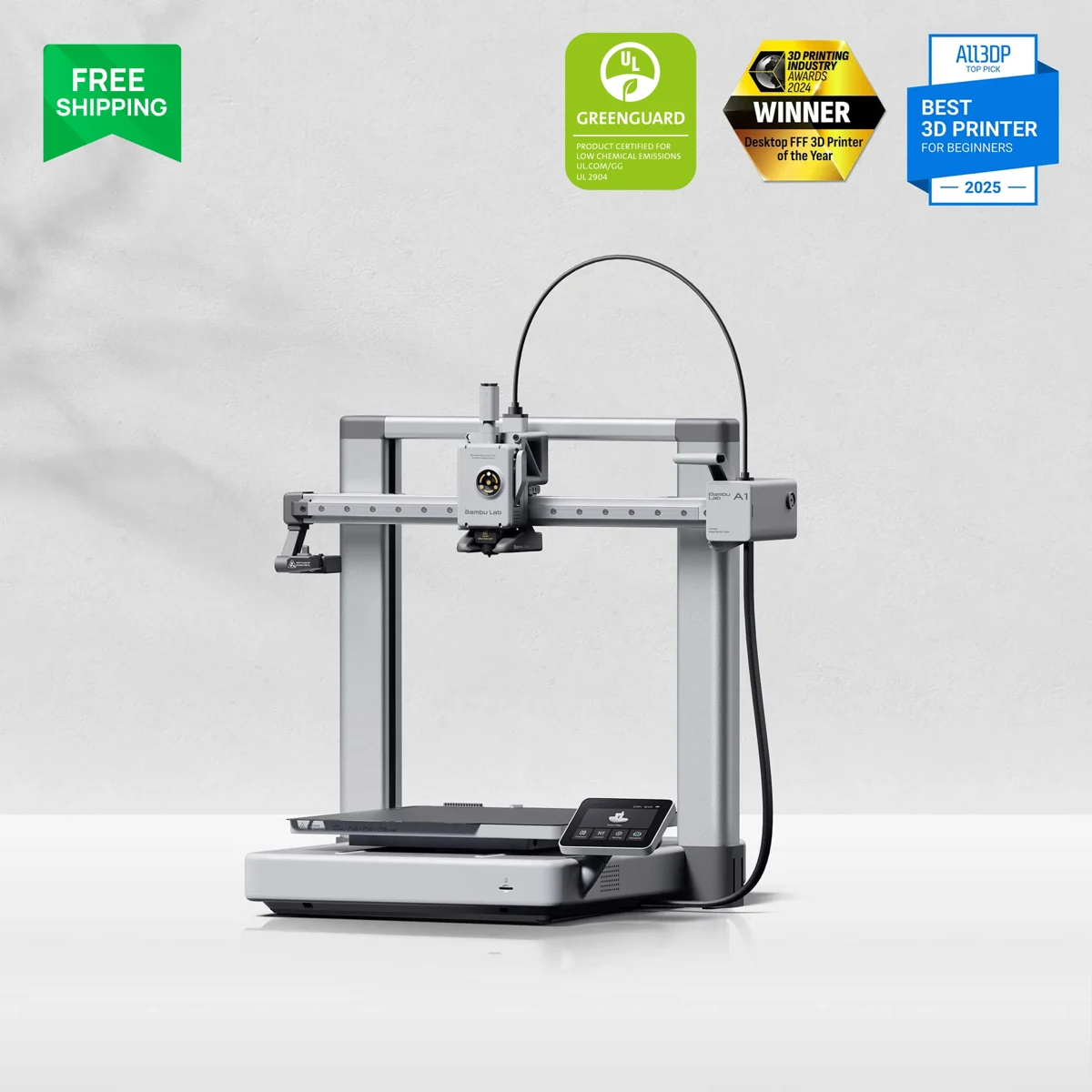
The A1 is most persuasive when the goal is to turn useful designs into physical objects without learning every mechanical adjustment first. A drawer organizer, a camera bracket prototype and a replacement board-game insert are better examples of its purpose than a claim that it can print anything. Its automatic setup addresses several frustrating early steps, while the open layout makes it easy to see what the machine is doing. This is a research assessment of that design and its published limits; we have not measured print quality, failure rate or noise on an A1.
The manufacturer specifies a 256 mm cube, a 300°C hotend and a 100°C bed. Those numbers describe different constraints. A model can fit the cube yet need support material, clearance or a different orientation, while a filament's extrusion temperature alone says little about whether the surrounding room is warm enough for a large part. The A1's practical appeal is that many everyday PLA and PETG projects fit comfortably within its intended workload. Buying it for ambitious engineering materials because the nozzle temperature sounds high would misunderstand the platform.
The moving bed changes the workspace
Unlike an enclosed CoreXY printer, the A1 moves the build plate back and forth during a job. The object therefore becomes part of the moving load. A tall narrow model asks more of adhesion and motion settings than a squat storage tray, even when both contain the same amount of plastic. We would be conservative with orientation and acceleration on tall decorative prints until the exact filament and model have been proven. The published maximum speed of 500 mm/s is a motion ceiling, not a promise that every visible wall can be printed that quickly.
Allow space around the complete travel of the bed, the cable and the spool path. A shelf that fits the static machine can still be a poor installation if the plate approaches its edge or the cable presses against the wall. The open frame also leaves hot and moving parts accessible. For a family workspace, placement should prevent casual contact during printing and preserve a clear view of the first layer. The bed's movement and the optional AMS lite are reasons to measure the working arrangement before choosing a desk.
Calibration helps; material preparation remains
Bambu describes automatic Z-offset, bed leveling, vibration compensation and nozzle-pressure calibration. The useful consequence is a shorter list of manual adjustments before an ordinary print. It does not mean contaminated build surfaces or damp filament cease to matter. If the first layer deteriorates after several jobs, a sensible diagnostic sequence starts with the plate and material before escalating into motion settings. Keep an example print and its saved profile after initial setup; changing the model, spool and settings together makes it harder to identify why a later result differs.
The official material guidance favors PLA, PETG, TPU and PVA, while warning about high-temperature polymers on this open machine. Bambu also explicitly advises against enclosing the A1. That matters to a buyer imagining an easy cabinet upgrade into an ABS production tool. A high-temperature material trial on a small part is not evidence that a broad, dense enclosure will remain flat or bond well. Filled and abrasive filaments also bring nozzle requirements: the stock stainless nozzle should not be treated as a universal wear-resistant solution simply because the extruder can push the material.
Colors are an accessory workflow
The A1 Combo includes AMS lite; the standalone printer does not. Four-color jobs through one AMS lite expand creative possibilities without giving the machine four independent nozzles. Each transition still requires managing the change of material through a shared extrusion path. A simple colored logo near the top of a model can therefore be a much more efficient project than a small object with many changes on every layer. Before starting a long decorative job, inspect the sliced estimate, transition count and waste as carefully as the rendered preview.
Current Bambu documentation also lists compatibility with other AMS systems through its specified A1-series hub. That is an important update to older advice that described the A1 as AMS-lite-only. It is still necessary to check the exact hub, feeder, firmware and material combination before buying accessories. Do not infer that a filament suitable for external feeding is automatically suitable for every automated feeder. For someone mainly producing single-color workshop parts, learning the base printer first is a reasonable way to discover whether automated changes solve an actual recurring task.
Controls, monitoring and ownership
The A1's current product information describes cloud access and a LAN-only mode. That gives privacy-conscious owners a concrete local-network option to investigate, rather than requiring every project to begin with a cloud upload. The associated mobile and remote workflow can differ when local-only operation is selected, so decide which features matter before configuring the machine. The low-frame-rate camera is best understood as a progress view. It cannot establish dimensional accuracy, check the hidden underside of a print or replace watching the first few layers of an unfamiliar job.
The quick-change nozzle is a welcome ownership feature because it makes the choice between detail and output less intimidating. A small nozzle can better resolve fine features but increases printing time and becomes a less attractive pairing with particle-filled materials. A larger nozzle changes the sliced geometry as well as throughput. Keep nozzle size, selected profile and actual installed hardware synchronized. Budget for build-plate care, replacement wipers and cutters where used, filament storage and occasional troubleshooting, not just spools. The accessible mechanism helps with inspection but still requires following the model's maintenance instructions.
Recall history and the purchase decision
The original A1 heatbed-cable recall is material to any used purchase. Bambu's February 2024 notice expanded the recall to the A1 units then in the market; the current product page says current sales contain the necessary cable fixes and describes the reinforced cable. A seller's clean-looking machine is not enough evidence that an older unit received the remedy. Match its history to the official recall information and obtain confirmation before using an affected machine. This history should be documented accurately rather than silently applied to every later A1 or dismissed because a printer powers on.
Our product request resolved to Bambu's Canadian store, which provided regional ordering and warranty information. A US buyer should use the corresponding US storefront; promotional windows and coverage should be checked for the actual country and seller. The A1 earns its place for accessible, ordinary filament work, while an enclosed alternative is the more logical starting point when demanding thermal conditions are central. Hands-on evaluation should prioritize tall-part stability, first-layer consistency after nozzle changes, actual workspace noise and recovery from filament problems. Those are the unanswered details that determine whether its convenience lasts beyond the first successful print.
Sources & further reading.
These are the sources behind this research review. Manufacturer claims are not independent performance measurements. Community accounts, when cited, describe individual experiences.
- Bambu A1 — current Canadian product specifications and FAQ ↗manufacturer
- Bambu A1 quick-start guide ↗manual
- Bambu A1 recall update, February 2024 ↗support
- US CPSC A1 recall notice ↗support
Documentation reviewed: 9 October 2026. Product software and regional bundles can change. Corrections and editorial disclosures.